Ripple has secured regulatory approval in Singapore to expand its payment services using XRP and its dollar-backed stablecoin RLUSD. The new authorisation comes under the company’s Major Payment Institution licence, held by its subsidiary Ripple Markets APAC. As one of the world’s most advanced financial centers, Singapore offers a strong regulatory environment that makes it ideal for growing real-world crypto payment solutions.
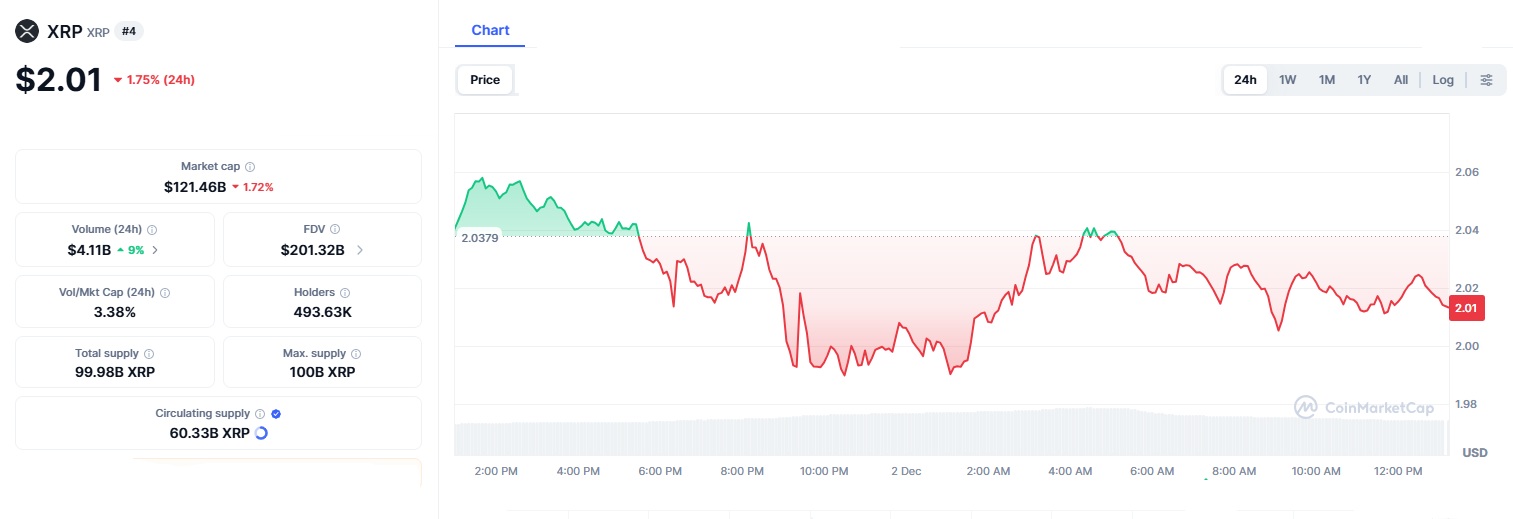
This approval arrives at a notable moment for Ripple’s ecosystem. XRP reached a new all-time high earlier this year, breaking a seven-year record by climbing to $3.65. But the momentum cooled, and XRP has since fallen about 45% from that peak, recently trading near $2.00. Even with market fluctuations, Ripple’s push for regulated expansion signals a long-term focus on real utility rather than short-term price movements.
The Monetary Authority of Singapore (MAS) is widely respected for its strict standards on digital assets. Ripple’s newly expanded licence means the company has met strong requirements for compliance, security, and consumer protection. With this approval, Ripple can now offer a wider range of regulated payment services that use XRP and RLUSD for fast and transparent cross-border transactions.
🚨🇸🇬 Singapore has officially approved Ripple to expand its payment operations under its Major Payment Institution license #XRP #XRPCommunity pic.twitter.com/KTkoLNVDnR
— BULLRUNNERS (@BullrunnersHQ) December 1, 2025
Ripple says its Payments platform is designed to help banks, fintechs, and crypto companies move money quickly without requiring major new infrastructure. Businesses can settle payments in minutes using digital tokens, connect through a single onboarding process rather than managing multiple partners, and access digital assets without needing additional bank relationships.
Ripple President Monica Long said the company values Singapore’s “regulatory clarity” and called it proof that innovation thrives when rules are clear. She added that the new approval strengthens Ripple’s ability to invest in Singapore and support financial institutions seeking faster and safer ways to move money.
The Asia Pacific region has become a global leader in real blockchain usage. Ripple noted that on-chain activity in APAC has grown about 70% year-over-year, and Singapore sits at the center of this growth. The country’s advanced digital infrastructure and clear regulations make it an ideal base for expanding crypto-powered payment services.
With its new licence, Ripple can better support the institutions fueling this growth. Faster settlement times, reduced costs, and transparent payment rails could reshape how businesses and individuals send money across borders. For companies operating across Asia, this could mean quicker access to liquidity and simpler ways to manage international payments.
RLUSD also plays an important role in this model. Designed to maintain a stable value, the stablecoin offers predictability during transfers, which can be useful in regions where local currencies are more volatile. Meanwhile, XRP provides liquidity and fast settlement, giving users two options depending on their needs.
XRP’s surge to $3.65 in July marked its highest price in seven years, driven by optimism around regulatory progress and expectations of future ETF approvals. But cryptocurrency markets remain unpredictable. XRP has dropped roughly 20% over the last 30 days, including a 1.72 % dip in the past 24 hours, leaving its price near $2.00.
RLUSD, Ripple’s stablecoin, is designed to avoid this type of volatility. It currently holds a market cap of about $1.26 billion and sees around $79 million in daily trading volume. Its predictable value and growing liquidity make it increasingly relevant as Ripple expands its payments ecosystem.
Even with strong regulatory backing, broader adoption of XRP and RLUSD payments will take time. Crypto payments require liquidity, reliable conversion between fiat and digital assets, and support from banks and payment platforms throughout the region. These elements continue to evolve.
Regulatory differences across countries may also influence how quickly Ripple’s model spreads beyond Singapore. While Singapore provides clarity, other jurisdictions in Asia are still shaping their frameworks for stablecoins and digital tokens.
XRP’s price volatility is another consideration. Users who prefer predictable value during transfers may lean toward RLUSD, while those prioritizing liquidity and speed may choose XRP. Understanding the strengths of each asset will help users make informed decisions.
The Road Forward for Ripple
Ripple’s expanded licence in Singapore shows how regulated, real-world crypto payments are steadily moving from vision to reality. With clear rules, strong infrastructure, and growing demand across Asia Pacific, Ripple is positioning XRP and RLUSD to play a larger role in the future of cross-border money movement one step at a time.
As more countries adopt clearer crypto regulations, do you think regulated digital payments will become a mainstream alternative to traditional banking?
Stay informed with daily updates from Blockchain Magazine on Google News. Click here to follow us and mark as favorite: [Blockchain Magazine on Google News].
Disclaimer: Any post shared by a third-party agency are sponsored and Blockchain Magazine has no views on any such posts. The views and opinions expressed in this post are those of the clients and do not necessarily reflect the official policy or position of Blockchain Magazine. The information provided in this post is for informational purposes only and should not be considered as financial, investment, or professional advice. Blockchain Magazine does not endorse or promote any specific products, services, or companies mentioned in this posts. Readers are encouraged to conduct their own research and consult with a qualified professional before making any financial decisions.
About the Author: John Brok