
- 100M UNI burn cut supply by ~$600M, marking one of DeFi’s largest single onchain reductions.
- Fee-driven burns now link UNI supply to protocol usage, replacing treasury accumulation.
- Circulating supply falls near 730M UNI as price and volume rise post-burn.
Uniswap has completed one of the largest single supply reductions recorded in decentralized finance, permanently removing 100 million UNI tokens from circulation in a single onchain transaction executed in late December. The burn reduced the token’s available supply and marked a structural change in how value is captured within the protocol.
At the current market prices at the time of execution, the destroyed tokens were valued at close to $600 million. The transaction immediately tightened UNI’s supply profile and altered how the market evaluates the asset’s circulating supply and long-term structure.
Supply Reduction Alters UNI Economics
The burn reflects a shift away from treasury accumulation toward direct supply reduction. Rather than retaining excess protocol revenue, Uniswap has implemented a framework that redirects a portion of fees toward systematic UNI destruction once operational costs are met.
Uniswap 的费用销毁提案在前天通过后,1 亿枚 $UNI ($5.96 亿) 在今天凌晨四点半从 Uniswap 财库完成了销毁。
根据提案,后续 Uniswap 收取的费用也将用于 $UNI 销毁。
———————————————————
本文由 @Bitget 赞助|Bitget… https://t.co/NpulKc617X pic.twitter.com/78hjhnJv9g— 余烬 (@EmberCN) December 28, 2025
This mechanism links token supply dynamics more closely to protocol usage. Fees generated across parts of Uniswap’s infrastructure, including Ethereum-based pools and Unichain, now contribute to reducing the number of UNI tokens in circulation. As a result, trading activity directly affects supply levels.
Following the burn, circulating supply declined to approximately 730 million UNI, well below earlier levels associated with the protocol’s fixed supply design.
Market Data Reflects Immediate Impact
Market activity shifted shortly after confirmation of the burn. UNI recorded a price increase alongside higher trading volumes, reflecting renewed market attention. At the time of reporting, UNI was trading at $6.28, representing a 6.03% increase over the prior 24 hours.
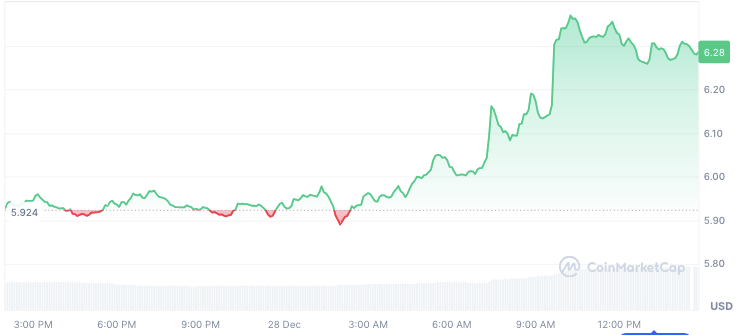
Source: CoinMarketCap
According to CoinMarketCap data, Uniswap’s 24-hour trading volume stood at $302.5 million, while its market capitalization reached approximately $4.6 billion. The token ranked #24 by market cap.
Governance Approval and Funding Allocation
The burn was executed following governance authorization, with support described as near-unanimous. Although the vote formalized the action, the outcome reflected alignment among stakeholders on revising UNI’s economic structure.
Separately, Uniswap’s foundation confirmed that ecosystem development funding remains intact. A dedicated allocation of 20 million UNI has been reserved for builders, infrastructure, and ecosystem support, distinct from the tokens that have been removed from circulation.
Stay informed with daily updates from Blockchain Magazine on Google News. Click here to follow us and mark as favorite: [Blockchain Magazine on Google News].
Disclaimer: Any post shared by a third-party agency are sponsored and Blockchain Magazine has no views on any such posts. The views and opinions expressed in this post are those of the clients and do not necessarily reflect the official policy or position of Blockchain Magazine. The information provided in this post is for informational purposes only and should not be considered as financial, investment, or professional advice. Blockchain Magazine does not endorse or promote any specific products, services, or companies mentioned in this posts. Readers are encouraged to conduct their own research and consult with a qualified professional before making any financial decisions.
About the Author: Peter Mwangi

