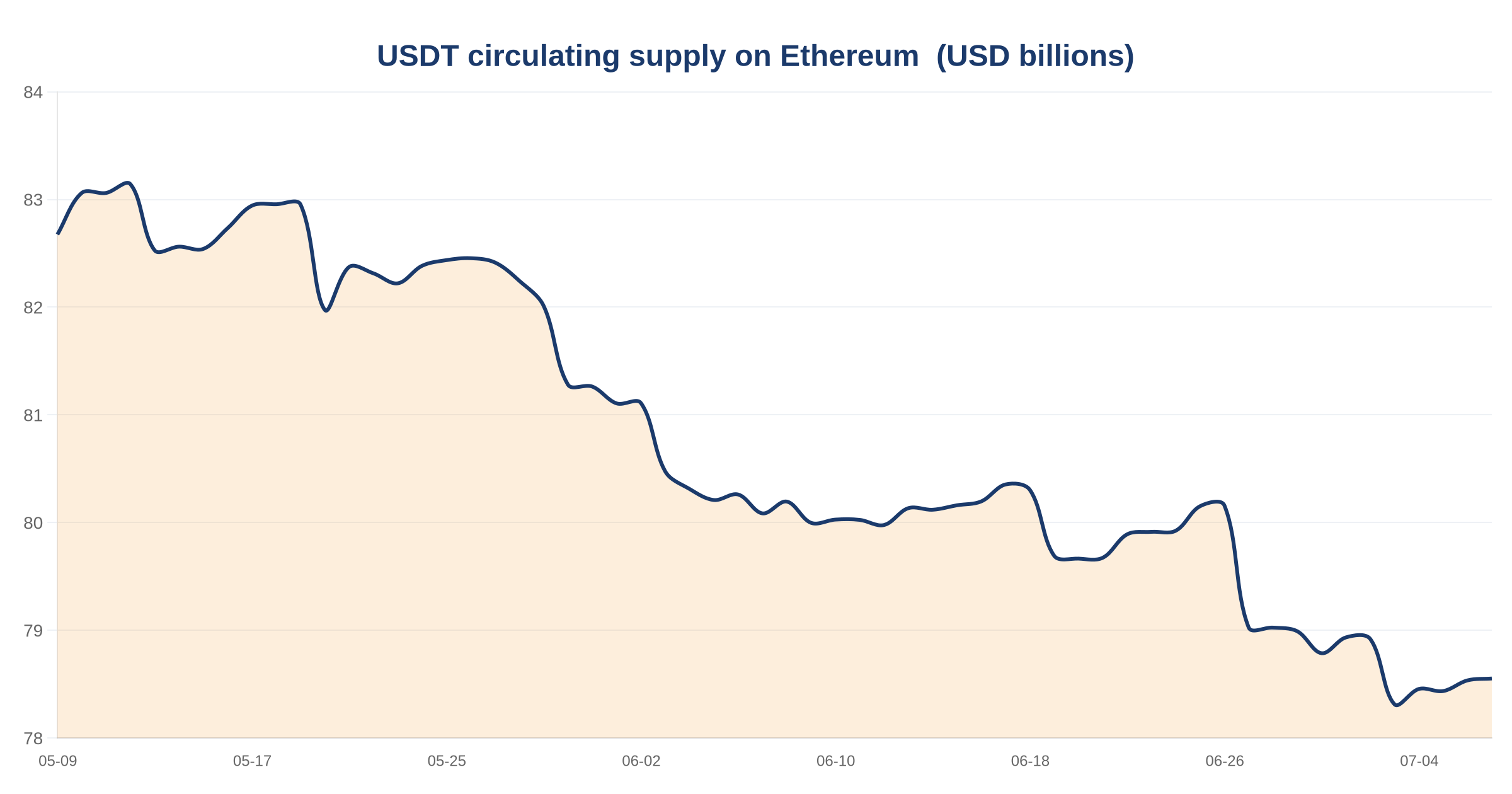
USDT circulating supply on Ethereum declined 1.93% over 30 days to $78.54B as of July 7, 2026.
Key takeaways
- USDT circulating supply on Ethereum declined 1.93% over 30 days to $78.54B as of July 7, 2026.
- USDC circulating supply on Ethereum fell 3.32% over 30 days to $46.85B as of July 7, 2026.
- Ethereum’s DeFi total value locked increased 10.13% to $39.84B over the same 30-day period despite stablecoin supply contraction.
- Ethereum held 42.61% of total USDT in circulation ($78.54B of $184.33B) and 64.02% of total USDC in circulation ($46.85B of $73.18B) as of July 7, 2026.
Ethereum Stablecoin Supply Contracts as DeFi TVL Climbs
Money left Ethereum’s stablecoins over the 30 days to July 7, 2026, but it didn’t leave the chain. TVL climbed as USDT and USDC both shrank, and that split tells you something about where capital actually went.
Start with the stablecoins. USDT’s circulating supply on Ethereum slipped from $80.09B on June 7, 2026 to $78.54B by July 7, 2026, a 1.93% decline. USDC fell harder over the same window, from $48.46B to $46.85B, off 3.32%. Those two tokens make up most of Ethereum’s total USD-pegged stablecoin supply, which sat at $152.96B as of July 7, 2026.
DeFi ran the other way. Total value locked on Ethereum rose from $36.18B to $39.84B across the trailing 30 days, a 10.13% gain, landing at $39.84B as of July 7, 2026. Stablecoin supply down, TVL up: the cleanest read is that capital rotating into DeFi protocols leaned toward non-stablecoin assets over the period.
Trading throughput didn’t follow the TVL story. DEX volume on Ethereum over the 24 hours ending July 7, 2026 was $1.14B, and the trailing 30-day trend was down 22.35%. That $1.14B still claimed 17.56% of the $6.49B traded across all chains in the same window.
Chain Share and Cross-Chain Context
Even as supply contracts, Ethereum remains the primary settlement layer for both major stablecoins in absolute terms. As of July 7, 2026:
- Ethereum held $78.54B of the $184.33B total USDT in circulation, a 42.61% chain share.
- Ethereum held $46.85B of the $73.18B total USDC in circulation, a 64.02% chain share.
USDC leans on Ethereum far more heavily than USDT does: 64.02% against 42.61%. A larger slice of USDC’s total issuance lives on Ethereum than is the case for USDT.
Why It Matters
Both USDT and USDC contracted on Ethereum during the same 30 days that DeFi TVL rose 10.13%. Supply and protocol-level value locked don’t have to move together, and here they didn’t. Stablecoins work as a proxy for idle or deployable capital on a chain, so shrinking supply against rising TVL points to some on-chain capital moving out of stablecoin holdings and into other asset types. The 22.35% drop in 30-day DEX volume, set beside that rising TVL, says protocol activity wasn’t converting into proportionately higher trading on Ethereum’s decentralized exchanges. Holding 64.02% of all USDC and 42.61% of all USDT as of July 7, 2026, Ethereum still anchors a substantial share of stablecoin liquidity across the wider crypto ecosystem, even with supply trending lower.
Disclaimer: Market data is informational only and not investment advice. Figures are accurate as of the stated dates and change continuously.
Featured illustration is AI-generated.
Frequently Asked Questions
Why did USDT and USDC supply decline on Ethereum over the past 30 days?
USDT circulating supply on Ethereum declined 1.93% to $78.54B and USDC fell 3.32% to $46.85B as of July 7, 2026. The article suggests capital rotated out of stablecoin holdings into other asset types, as evidenced by DeFi TVL rising 10.13% during the same period despite stablecoin supply contraction.
What is Ethereum’s share of total USDT and USDC supply?
As of July 7, 2026, Ethereum held 42.61% of total USDT in circulation ($78.54B of $184.33B) and 64.02% of total USDC in circulation ($46.85B of $73.18B), making it the primary settlement layer for both stablecoins.
Did Ethereum DEX trading volume grow alongside the rise in DeFi TVL?
No. While Ethereum’s DeFi TVL increased 10.13% to $39.84B over the 30 days ending July 7, 2026, DEX volume on Ethereum declined 22.35% over the same period, suggesting protocol activity did not convert into proportionately higher trading volume.
Data & sources
Every figure in this article is pulled from live on-chain data and linked to its source and the date it was read.
- Total stablecoin supply on chain: $152.96B (as of 2026-07-07) — source [API]
- DeFi TVL: $39.84B (as of 2026-07-07) — source [API]
- DeFi TVL 30-day change: +10.13% (as of 2026-07-07) — source [API]
- DEX volume (24h): $1.14B (as of 2026-07-07) — source [API]
- DEX volume 30-day change: -22.35% (as of 2026-07-07) — source [API]
- Share of all DEX volume: +17.56% (as of 2026-07-07) — source [API]
- Stablecoin supply on chain: $78.54B (as of 2026-07-07) — source [API]
- Stablecoin 30-day supply change: -1.93% (as of 2026-07-07) — source [API]
- Stablecoin chain share: +42.61% (as of 2026-07-07) — source [API]
- Stablecoin supply on chain: $46.85B (as of 2026-07-07) — source [API]
- Stablecoin 30-day supply change: -3.32% (as of 2026-07-07) — source [API]
- Stablecoin chain share: +64.02% (as of 2026-07-07) — source [API]
Methodology: every figure above links to its live on-chain source (DeFiLlama, CoinGecko) and the date it was read; analysis by Blockchain Magazine. Informational only, not investment advice.
Stay informed with daily updates from Blockchain Magazine on Google News. Click here to follow us and mark as favorite: [Blockchain Magazine on Google News].
Disclaimer: Any post shared by a third-party agency are sponsored and Blockchain Magazine has no views on any such posts. The views and opinions expressed in this post are those of the clients and do not necessarily reflect the official policy or position of Blockchain Magazine. The information provided in this post is for informational purposes only and should not be considered as financial, investment, or professional advice. Blockchain Magazine does not endorse or promote any specific products, services, or companies mentioned in this posts. Readers are encouraged to conduct their own research and consult with a qualified professional before making any financial decisions.
About the Author: John Brok