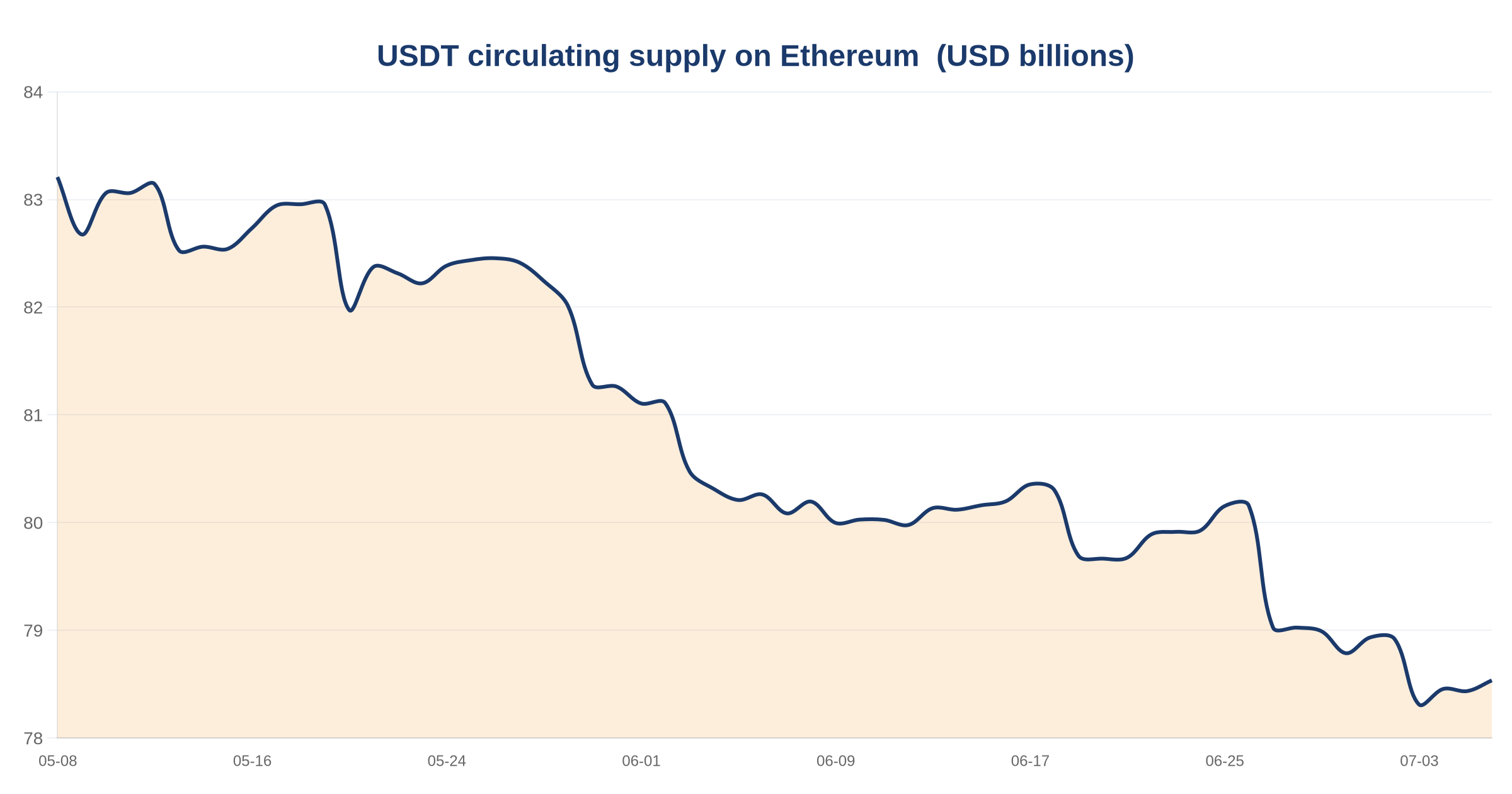
USDT supply on Ethereum fell 2.14% to $78.54B over 30 days to July 6, 2026, while USDC declined 3.84% to $46.64B over the same period.
Key takeaways
- USDT supply on Ethereum fell 2.14% to $78.54B over 30 days to July 6, 2026, while USDC declined 3.84% to $46.64B over the same period.
- Ethereum DeFi TVL rose 10.13% to $39.92B over 30 days to July 6, 2026, despite combined stablecoin supply on the network contracting.
- Ethereum DEX volume collapsed 81.75% over 30 days to $491.59M in the 24 hours ending July 6, 2026, accounting for 10.49% of the $4.69B global on-chain DEX total.
- Ethereum holds 63.91% of all circulating USDC ($46.64B of $72.98B) and 42.61% of all circulating USDT ($78.54B of $184.30B) as of July 6, 2026.
Ethereum’s Stablecoin Base Shrank While DeFi Deposits Grew — Two Signals Pulling Apart
Here’s the tension in our July 6, 2026 snapshot: the two biggest dollar tokens on Ethereum both lost supply over 30 days, yet money kept flowing into the network’s DeFi protocols. USDC led the retreat, down 3.84% from $48.50B on June 6 to $46.64B. USDT slipped 2.14% over the same stretch, from $80.26B to $78.54B. Both still make up the bulk of the $152.96B in USD-pegged stablecoins circulating on Ethereum, but the direction of travel is down.
Ethereum Still Holds the Majority of Both Coins
Supply contracted, but concentration didn’t. Of the $184.30B in USDT outstanding across every chain, $78.54B lives on Ethereum: 42.61% of the global float. USDC leans even harder on the network, with $46.64B of its $72.98B total held here, or 63.91%. Set that combined $152.96B stablecoin pool against Ethereum’s $39.92B in DeFi TVL as of July 6, 2026, and the gap tells you most of these dollars sit idle rather than locked in active positions.
TVL Up 10.13%, DEX Volume Down 81.75%
The activity metrics split cleanly. DeFi TVL on Ethereum rose 10.13% over the trailing 30 days, climbing from $36.25B to $39.92B by July 6, 2026. Trading told the opposite story. DEX volume on Ethereum came in at $491.59M over the last 24 hours, an 81.75% drop from 30 days earlier. That $491.59M made up 10.49% of the $4.69B in on-chain DEX volume across all chains for the same window.
Key Figures at a Glance
- Total USD-pegged stablecoin supply on Ethereum: $152.96B (as of 2026-07-06)
- USDT on Ethereum: $78.54B (−2.14% over 30 days); 42.61% of all USDT ($184.30B)
- USDC on Ethereum: $46.64B (−3.84% over 30 days); 63.91% of all USDC ($72.98B)
- DeFi TVL on Ethereum: $39.92B (+10.13% over 30 days, from $36.25B)
- Ethereum DEX volume (24 hours): $491.59M (−81.75% over 30 days; 10.49% of $4.69B global total)
Why It Matters
USDT and USDC both losing supply on Ethereum in the same 30 days to July 6, 2026 reads as a net outflow of dollar liquidity from the network. Yet TVL rose 10.13% over the same period, which points to protocol deposits growing on something other than fresh stablecoin inflows. The 81.75% collapse in DEX volume sharpens that read: deposits climbed while trading thinned out. Because Ethereum still carries 63.91% of all circulating USDC and 42.61% of all circulating USDT, where those balances move next sets the terms for cross-chain liquidity everywhere else.
Disclaimer: Market data is informational only and not investment advice. Figures are accurate as of the stated dates and change continuously.
Featured illustration is AI-generated.
Frequently Asked Questions
What happened to USDT and USDC supply on Ethereum over the last 30 days?
USDT supply on Ethereum fell 2.14% to $78.54B, while USDC declined 3.84% to $46.64B over the 30 days to July 6, 2026. Both stablecoins experienced net outflows from the network during this period.
How much of the global USDT and USDC supply does Ethereum hold?
As of July 6, 2026, Ethereum holds 42.61% of all circulating USDT ($78.54B of $184.30B globally) and 63.91% of all circulating USDC ($46.64B of $72.98B globally).
Why did DeFi TVL on Ethereum increase while stablecoin supply decreased?
DeFi TVL on Ethereum rose 10.13% to $39.92B over 30 days despite stablecoin supply contracting, suggesting that protocol deposits grew from sources other than fresh stablecoin inflows. DEX volume collapsed 81.75% over the same period, indicating deposits climbed while trading activity thinned out.
Data & sources
Every figure in this article is pulled from live on-chain data and linked to its source and the date it was read.
- Total stablecoin supply on chain: $152.96B (as of 2026-07-06) — source [API]
- DeFi TVL: $39.92B (as of 2026-07-06) — source [API]
- DeFi TVL 30-day change: +10.13% (as of 2026-07-06) — source [API]
- DEX volume (24h): $491.59M (as of 2026-07-06) — source [API]
- DEX volume 30-day change: -81.75% (as of 2026-07-06) — source [API]
- Share of all DEX volume: +10.49% (as of 2026-07-06) — source [API]
- Stablecoin supply on chain: $78.54B (as of 2026-07-06) — source [API]
- Stablecoin 30-day supply change: -2.14% (as of 2026-07-06) — source [API]
- Stablecoin chain share: +42.61% (as of 2026-07-06) — source [API]
- Stablecoin supply on chain: $46.64B (as of 2026-07-06) — source [API]
- Stablecoin 30-day supply change: -3.84% (as of 2026-07-06) — source [API]
- Stablecoin chain share: +63.91% (as of 2026-07-06) — source [API]
Methodology: every figure above links to its live on-chain source (DeFiLlama, CoinGecko) and the date it was read; analysis by Blockchain Magazine. Informational only, not investment advice.
Stay informed with daily updates from Blockchain Magazine on Google News. Click here to follow us and mark as favorite: [Blockchain Magazine on Google News].
Disclaimer: Any post shared by a third-party agency are sponsored and Blockchain Magazine has no views on any such posts. The views and opinions expressed in this post are those of the clients and do not necessarily reflect the official policy or position of Blockchain Magazine. The information provided in this post is for informational purposes only and should not be considered as financial, investment, or professional advice. Blockchain Magazine does not endorse or promote any specific products, services, or companies mentioned in this posts. Readers are encouraged to conduct their own research and consult with a qualified professional before making any financial decisions.
About the Author: John Brok