
The global market for Islamic finance-compliant cryptocurrencies has grown to over $12 billion, offering Muslim investors diverse halal investment opportunities in digital assets. Muslims seeking shariah compliant crypto face unique challenges: identifying projects that truly align with Islamic finance principles while avoiding riba (usury), gharar (excessive uncertainty), and maysir (gambling). This comprehensive guide examines 12 leading halal crypto projects that meet Shariah requirements, providing Muslim investors with vetted options for ethical wealth creation in the blockchain space.
What Makes Cryptocurrency Sharia-Compliant?
Shariah compliant crypto projects must satisfy core Islamic finance principles.
Key Shariah Compliance Criteria:
- Prohibition of Riba (Interest): Projects must avoid interest mechanisms, fixed guaranteed returns, or lending protocols resembling conventional interest
- Avoidance of Gharar (Excessive Uncertainty): Smart contracts, tokenomics, and project documentation must be transparent with verifiable on-chain data
- Restriction of Maysir (Gambling): Excessive speculation, lottery mechanics, or gambling-like features are prohibited in halal crypto projects
- Asset-Backed Utility: Islamic finance prefers assets with real economic activity, clear use cases, and tangible value propositions
- Ethical Screening: Third-party Shariah boards or consulting firms provide certification to confirm compliance
Top 12 Sharia-Compliant Crypto Projects for Halal Investment
1. MECCACOIN – Faith-Focused Digital Asset for Muslim Investors
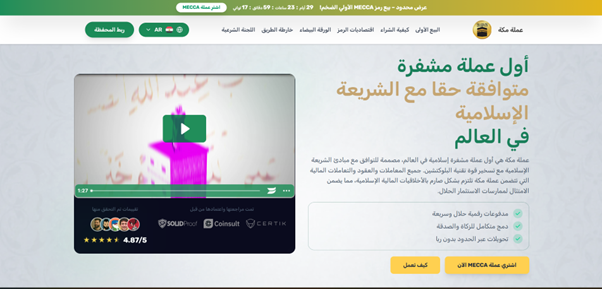
MECCACOIN bridges modern crypto culture with Islamic values for accessible halal investment.
MECCACOIN sits at the intersection of faith-focused design and community-driven cryptocurrency innovation, positioning itself as a premium Sharia-compliant cryptocurrency option specifically designed for Muslim investors worldwide. Unlike conventional cryptocurrencies that may inadvertently conflict with Islamic ethics, MECCACOIN explicitly embeds core Islamic values into its fundamental architecture, creating a digital asset that serves as a halal investment vehicle.
Key Features:
- Islamic Values Integration: Embeds tawhid (monotheism), amanah (trust), and adl (justice) into core architecture
- Zero Riba Structure: No interest-based yields or guaranteed fixed returns
- Transparent Tokenomics: Clear documentation minimizing gharar for informed halal investment decisions
- Community Governance: Combines memecoin energy with serious faith-focused infrastructure
- Accessible Platform: User-friendly registration through dedicated halal crypto portal
- Social Impact Focus: Values-driven ecosystem supporting ethical wealth creation
Official Website: https://meccacoin.meme/
2. Sidra Chain – Emerging Islamic Finance Blockchain Platform
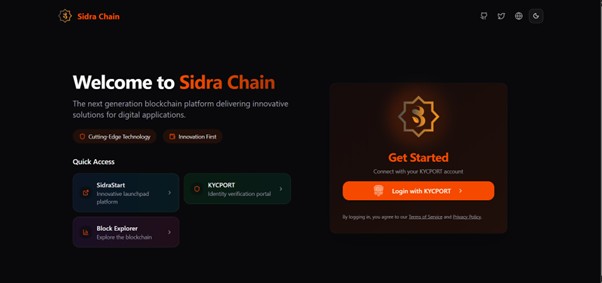
Sidra Chain combines Shariah compliance with supply chain transparency and halal tokenization.
Sidra Chain operates as a decentralized blockchain platform designed to integrate Islamic finance principles with cutting-edge digital technology. Launched in 2022 as an Ethereum fork, it ensures security and decentralization while adhering to Shariah directives prohibiting interest (riba), uncertainty (gharar), and speculation.
Key Features:
- Supply Chain Focus: Specializes in tracking halal food, pharmaceuticals, and cosmetics
- Blockchain-as-a-Service: Offers BaaS solutions for businesses seeking Islamic finance crypto integration
- Digital Asset Tokenization: Enables digitization and management of Shariah-compliant assets
- Qatar Recognition: Accepted into Qatar Digital Assets Lab for Middle East expansion
- Islamic Financial Products: Plans to offer Sukuk (Islamic bonds) and Murabaha financing
- Transaction Verification: Every transaction verified according to Islamic law to ensure halal investment
The platform was accepted into the Qatar Digital Assets Lab, expanding its influence in the Middle East and promoting halal cryptocurrency adoption among Muslim markets.
Official Website:
3. CAIZ Coin – European Islamic Fiqh-Compliant Crypto Ecosystem
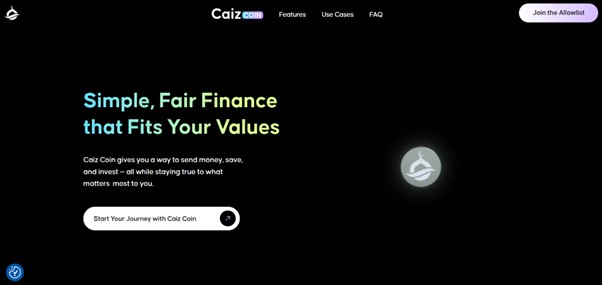
CAIZ Coin is the first EU-based Islamic fiqh-compliant ecosystem with deflationary tokenomics.
CAIZ operates as a decentralized financial system that combines the advantages of both decentralized and centralized platforms, creating a unique DeCe (decentralized-centralized) model. It includes a native token, stablecoins, an evolving native blockchain, intuitive digital wallet, analytics portal, and comprehensive mobile application.
Key Features:
- EU Compliance: First European crypto ecosystem compliant with Islamic fiqh
- Islamic Finance Business Account (IFBA): Unique banking solution for Muslim entrepreneurs
- DeCe Model: Hybrid decentralized-centralized platform balancing accessibility and compliance
- Deflationary Tokenomics: Designed to preserve and increase value over time
- Financial Inclusion: Dedicated to bridging the financial gap for marginalized communities
- Comprehensive Ecosystem: Complete suite including wallet, blockchain, and mobile app
Official Website:
4. Deenar Gold (DEEN) – Gold-Backed Halal Stablecoin
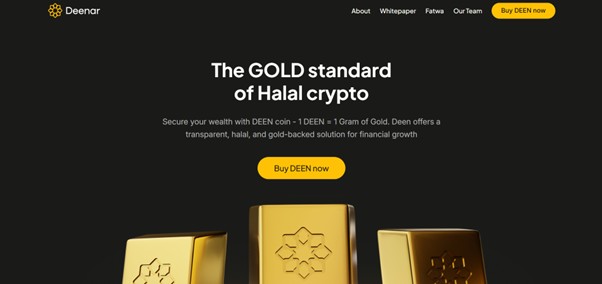
Deenar Gold pegs each token to physical gold for asset-backed halal investment.
Deenar Gold (DEEN) is a halal digital stablecoin where each token equals exactly 1 gram of physical gold stored in secure vaults. Built on the HAQQ Network, a blockchain specifically designed to comply with Islamic finance principles, DEEN combines modern blockchain technology with traditional gold value.
Key Features:
- 1:1 Gold Backing: Each DEEN token represents 1 gram of physical gold
- Shariah Certification: Formal fatwa issued by recognized Islamic scholars
- 100% Halal Compliance: Strictly adheres to Islamic finance principles
- Inflation Protection: Gold backing provides stability against currency devaluation
- Redemption Capability: Tokens can be exchanged for physical gold
- Charitable Component: 1% of transaction fees directed to Muslim charity platform Launch Good
- Zero Storage Fees: No ongoing costs for holding DEEN tokens
Deenar offers a transparent, halal solution backed by gold for financial growth, making it particularly attractive for Muslim investors seeking Sharia-compliant cryptocurrency with tangible asset backing.
Official Website:
5. Islamic Coin (ISLM) – Flagship Shariah-Compliant Blockchain Native Token
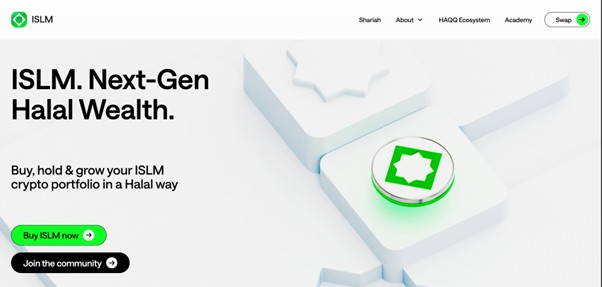
Islamic Coin operates as the native token of the HAQQ Network with explicit Islamic positioning.
Islamic Coin (ISLM) functions as the cornerstone cryptocurrency of the HAQQ Network blockchain platform, specifically built to deliver Sharia-compliant cryptocurrency solutions at scale.
Key Features:
- Shariah Oracle Technology: Automated ethical safeguard layer verifying smart contract compliance
- Evergreen DAO: 10% of all ISLM generated allocated to Islamic charitable initiatives worldwide
- Institutional Support: Partnerships with Indonesian Ulema Council and Kenya Fatwa Council
- Zero Riba: Avoids all interest-based transactions through decentralized P2P architecture
- Community Governance: ISLM stakers propose and vote on smart contract whitelisting
- Transparent Emission: Controlled token generation by validators maintains currency integrity
The project strictly adheres to Shariah principles across all transaction types, ensuring each operation complies with Islamic finance laws for authentic halal investment.
Official Website:
6. MRHB Network – DeFi Platform for Muslim Communities

MRHB creates ethical DeFi infrastructure specifically designed for faith-focused investors.
Marhaba DeFi Network (MRHB) focuses exclusively on creating halal cryptocurrency products and services tailored for Muslim communities and ethically conscious investors worldwide.
Key Features:
- Halal NFT Certification: World’s first certified halal compliance for NFTs
- SouqNFT Marketplace: Rigorous screening for modesty, morality, and authenticity
- Sahal Wallet: Halal crypto wallet for secure asset management
- $5.5M Raised: Successful initial DEX offering demonstrating market confidence
- 14+ Partnerships: Collaborations with major platforms including Polygon
- Comprehensive Screening: Verifies hate speech, racism, nudity, and ethical standards
Leveraging the $3 trillion Islamic finance economy, MRHB Network positions itself as a central player in halal investment opportunities through blockchain technology.
Official Website:
7. HAQQ Network – Shariah-Compliant Blockchain Ecosystem with $400M+ Funding
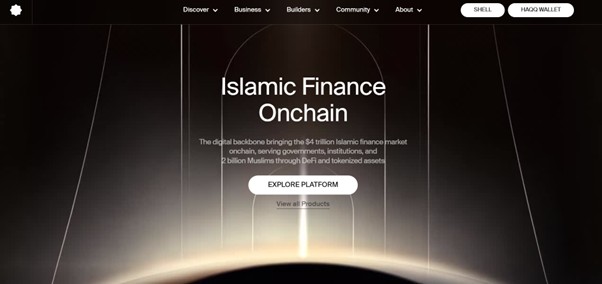
HAQQ Network serves 2 billion Muslims with blockchain solutions built for Shariah compliance.
HAQQ Network operates as a comprehensive Layer 1 blockchain (transitioning to Ethereum Layer 2) specifically designed to serve the global Muslim population with Islamic finance cryptocurrency infrastructure.
Key Features:
- Massive Scale: Over 6 million blockchain accounts and $400M funding
- Complete Ecosystem: HAQQex exchange, Sidra Bank, Deenar Gold, MM Chat social platform
- Built-In Shariah Oracle: Compliance embedded at protocol level ensuring every transaction is halal
- Layer 2 Migration: Advanced Ethereum L2 architecture for scalability and efficiency
- 10% to Charity: Evergreen DAO allocates significant portion to charitable causes
- Islamic Council Support: Partnerships with prominent religious authorities worldwide
Official Website:
8. Binance Sharia Earn – Certified Halal Staking Platform
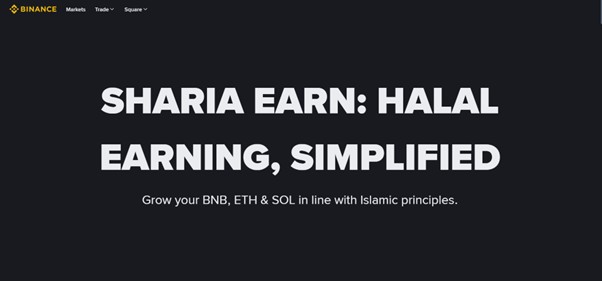
Binance Sharia Earn offers the world’s first multi-token halal staking certified by Islamic scholars.
Binance’s Sharia Earn product represents a landmark achievement in mainstream Sharia-compliant cryptocurrency adoption, providing certified halal staking services for major cryptocurrencies.
Key Features:
- Amanie Advisors Certification: Comprehensive review and certification by Shariah consulting
- Multiple Assets: Halal staking for BNB, ETH, SOL with plans for more tokens
- Wakalah Agreements: Profits from permissible sources, fully avoiding riba
- 50,000+ Users: Attracted mass adoption within 48 hours of launch
- Liquid Staking Options: WBETH and BNSOL tokens maintain liquidity while earning yield
- Zakat Calculation: Built-in tools supporting Muslim charitable obligations
- Institutional Expansion: Plans for partnerships with Islamic banks and family offices
This Islamic finance cryptocurrency product underwent comprehensive review to ensure full compliance with Islamic principles, making halal investment accessible to mainstream users.
Official Website:
https://www.binance.com/en/events/sharia-earn
9. Stellar (XLM) – Cross-Border Payments for Financial Inclusion
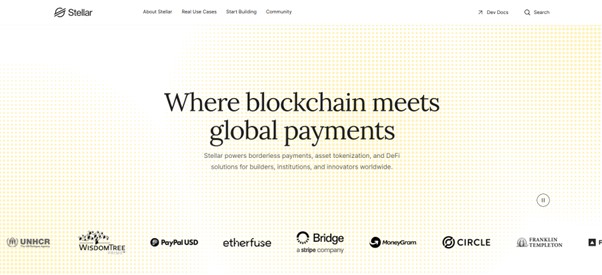
Stellar Network specializes in cross-border payments and financial inclusion, providing blockchain infrastructure particularly valuable for remittances and microfinance in underserved regions.
Key Features:
- Shariah Certificate: First blockchain protocol certified for remittances and asset tokenization
- Low-Cost Remittances: Fast, affordable international transfers without intermediaries
- Financial Inclusion: Mission focused on serving underbanked Muslim markets
- Clear Utility: Transparent operations beyond pure speculation for halal investment
- Diaspora Support: Ideal for charity (sadaqah) and family remittances in Muslim communities
- Energy Efficiency: Green consensus mechanism addressing environmental concerns
The network’s native XLM token facilitates transactions critical for Muslim-majority countries and large diasporas, aligning with Islamic principles of economic justice and community support.
Official Website:
10. Algorand (ALGO) – Green Blockchain for Institutional Finance
Algorand’s transparent consensus and institutional adoption support Shariah compliance.
Algorand stands out as an environmentally sustainable blockchain platform powering CBDCs, tokenized real-world assets, and compliant DeFi applications.
Key Features:
- 27-Factor Verification: Comprehensive Shariah compliance assessment across multiple dimensions
- Pure Proof-of-Stake: Energy-efficient consensus designed by Turing Award laureate
- Institutional Adoption: CBDCs and real-world asset tokenization for genuine economic utility
- Transparent Documentation: Clear technical specifications reducing gharar for Muslim investors
- Security Audits: Third-party verification from QuillAudits and BlockApex
- Regulatory Compliance: Strong focus on US and international regulatory standards
The comprehensive assessment examines project transparency, team authority, use cases, and ethical operations, making ALGO suitable for Sharia-compliant cryptocurrency portfolios.
Official Website:
11. Ethereum (ETH) – Largest Smart Contract Platform with Halal Verification

Ethereum offers programmable blockchain utility when verified for Shariah compliance.
Ethereum functions as the world’s largest smart contract platform, powering decentralized applications and forming the infrastructure foundation for much of the Islamic finance crypto ecosystem.
Key Features:
- Binance Sharia Earn Integration: Certified halal staking through WBETH liquid tokens
- Amanie Advisors Endorsement: Formal Shariah certification for specific staking implementations
- Proof-of-Stake: Energy-efficient consensus replacing mining for environmental responsibility
- Islamic DeFi Foundation: Infrastructure supporting MRHB Network and HAQQ Layer 2
- Programmable Compliance: Smart contracts enable Shariah-compliant DeFi protocols
- Screening Available: Evaluated by Zoya and other Islamic finance apps
Major halal crypto projects received formal certification for Ethereum staking, demonstrating that ETH can be used in Sharia-compliant cryptocurrency platforms when properly structured.
Official Website:
12. Cardano (ADA) – Research-Based Blockchain with Halal Verification
Cardano operates as a third-generation blockchain platform built through peer-reviewed academic research, emphasizing transparency, sustainability, and methodical development.
Key Features:
- Academic Foundation: Peer-reviewed research creates clear documentation reducing gharar
- Multiple Screening Lists: Appears on various Shariah screening platforms as compliant
- Financial Inclusion: Focus on African nations with significant Muslim populations
- Proof-of-Stake: Participation-based rewards potentially permissible when properly structured
- On-Chain Governance: Transparent voting aligns with Islamic consultation principles (shura)
- Long-Term Sustainability: Emphasis on responsible development over speculation
The platform’s scientific approach facilitates Sharia-compliant cryptocurrency verification, with transparent governance and sustainability resonating with Islamic stewardship principles (amanah) for halal investment.
Official Website:
How to Verify Cryptocurrency for Shariah Compliance
Muslim investors can follow systematic steps to independently assess halal crypto projects.
Step-by-Step Cryptocurrency Shariah Verification:
- Check Project Utility: Ensure the cryptocurrency serves a clear economic purpose beyond pure speculation
- Examine Interest Mechanisms: Investigate whether the project includes riba through fixed interest payments or guaranteed yields
- Assess Transparency: Review whitepapers, tokenomics, and on-chain data to minimize gharar
- Evaluate Core Activity: Confirm the project doesn’t facilitate prohibited industries
- Use Screening Apps: Utilize specialized platforms like Zoya, Musaffa, or Crypto Ummah that apply AAOIFI standards
- Consult Scholars for Guidance: Seek advice from Islamic finance scholars or Shariah advisory boards
- Monitor Ongoing Compliance: Regularly reassess holdings as projects evolve
Comparison of Top Sharia-Compliant Cryptocurrencies
| Project | Primary Focus | Shariah Certification | Unique Halal Feature |
| Mecca Coin | Faith-focused community token | Shariah-focused design | Combines meme culture with Islamic values |
| Sidra Chain | Supply chain & tokenization | Shariah-compliant design | Qatar Digital Assets Lab member |
| CAIZ Coin | EU-based fiqh ecosystem | Islamic fiqh compliance | DeCe model with IFBA features |
| Deenar Gold (DEEN) | Gold-backed stablecoin | Certified by formal fatwa | 1 gram physical gold per token |
| Islamic Coin (ISLM) | Blockchain native token | Shariah oracle + Council | 10% to charity via Evergreen DAO |
| MRHB Network | Halal DeFi services | Certified NFT compliance | Halal SouqNFT marketplace |
| HAQQ Network | Complete blockchain ecosystem | Multiple Islamic councils | $400M funding, 6M+ accounts |
| Binance Sharia Earn | Certified staking platform | Amanie Advisors certification | Institutional-grade accessibility |
| Stellar (XLM) | Cross-border payments | Shariah certificate for transfers | Financial inclusion focus |
| Algorand (ALGO) | Green institutional blockchain | 27-factor verification | Energy efficiency, CBDC-ready |
| Ethereum (ETH) | Smart contract platform | Via screening + certified staking | Infrastructure for Islamic DeFi |
| Cardano (ADA) | Research-based blockchain | Via screening services | Peer-reviewed transparency |
Frequently Asked Questions About Sharia-Compliant Cryptocurrency
Is cryptocurrency halal or haram in Islam?
Cryptocurrency itself is neither halal nor haram; compliance depends on each project’s structure, purpose, and usage. Projects like Islamic Coin and MECCACOIN are specifically designed as halal crypto projects, while mainstream cryptocurrencies may be halal when properly verified.
How do I know if a crypto project is Shariah-compliant?
Use dedicated screening platforms like Zoya, Musaffa, or Crypto Ummah that apply AAOIFI standards. Check for formal Shariah certification from recognized consulting firms like Amanie Advisors. Review project documentation for transparency and verify absence of interest-based mechanisms.
Can I stake cryptocurrency in a halal way?
Yes, when staking avoids riba-like structures and uses certified platforms. Binance Sharia Earn offers formally certified halal staking through wakalah agreements that ensure profits come from permissible sources rather than interest.
How is MECCACOIN different from other Islamic crypto projects?
MECCACOIN uniquely combines community-driven memecoin culture with serious faith-focused design, creating an accessible entry point for Muslims new to Islamic finance crypto while maintaining Shariah compliance through transparent tokenomics and values-based governance.
Are gold-backed cryptocurrencies automatically halal?
Gold-backed tokens like Deenar Gold are generally more aligned with Islamic finance principles due to tangible asset backing, but still require proper Shariah certification. The backing must be verifiable, the token structure must avoid riba, and the project should have formal fatwa approval from qualified Islamic scholars for true halal investment status.
Core Islamic Finance Principles for Crypto Investing
Understanding fundamental Islamic concepts enables better assessment of halal crypto projects.
Essential Islamic Finance Principles:
- Prohibition of Riba (Interest): All forms of predetermined, guaranteed returns on capital are forbidden
- Avoidance of Gharar (Uncertainty): Excessive ambiguity in contracts or opaque operations violate Islamic principles
- Restriction of Maysir (Gambling): Transactions resembling gambling or pure speculation are prohibited
- Halal Underlying Assets: Investments must not involve prohibited industries
- Risk Sharing: Islamic finance prefers partnership models where profits and losses are distributed fairly
- Asset Backing: Preferred investments have tangible underlying value or clear economic utility
- Social Responsibility: Islamic finance encourages wealth circulation and charity alongside profit generation
Conclusion
The Sharia-compliant cryptocurrency landscape has evolved significantly, offering Muslim investors diverse halal investment pathways—from purpose-built Islamic finance cryptocurrency platforms like MECCACOIN, Islamic Coin, and HAQQ Network, to gold-backed stablecoins like Deenar Gold, and emerging ecosystems like Sidra Chain and CAIZ Coin. Each of the 12 halal crypto projects reviewed demonstrates how blockchain technology can align with Islamic principles—avoiding riba, gharar, and maysir while providing genuine economic utility and transparent governance.
MECCACOIN stands out in this expanding ecosystem by uniquely bridging community-driven cryptocurrency meme culture with serious faith-focused infrastructure, making shariah compliant crypto accessible and appealing to Muslims worldwide.
Whether you choose dedicated Islamic blockchain platforms, gold-backed stablecoins with formal fatwa certification, certified staking services, or verified mainstream digital assets, you now have the tools and guidance needed to build diversified halal investment portfolios. This complete Islamic finance guide to Sharia-compliant cryptocurrency demonstrates that faith and innovation can coexist, creating ethical wealth-building opportunities aligned with Islamic values.
Stay informed with daily updates from Blockchain Magazine on Google News. Click here to follow us and mark as favorite: [Blockchain Magazine on Google News].
Disclaimer: Any post shared by a third-party agency are sponsored and Blockchain Magazine has no views on any such posts. The views and opinions expressed in this post are those of the clients and do not necessarily reflect the official policy or position of Blockchain Magazine. The information provided in this post is for informational purposes only and should not be considered as financial, investment, or professional advice. Blockchain Magazine does not endorse or promote any specific products, services, or companies mentioned in this posts. Readers are encouraged to conduct their own research and consult with a qualified professional before making any financial decisions.
About the Author: John Brok

