
Monero’s price was pushing above the $420 area on Wednesday as traders rotated back into privacy assets, a niche of the crypto market that has been unusually quiet this quarter but is now showing some signs of life. Screens across several trading desks seen by BlockchainMagazine.net showed a pickup in XMR volumes during the early Asian session, with one OTC desk describing the flow as “old money nibbling again,” though it’s not clear yet whether this is a sustained trend or just a short squeeze.
The move — roughly a 6–10% gain over 24 hours depending on the venue — comes as broader majors traded mostly flat. Bitcoin and ether were in the green but not by much, and that contrast alone was enough for some quant traders to flag Monero as one of the day’s better-performing large-caps. Market-cap estimates hovered around $7.7 billion, and while the absolute numbers aren’t extraordinary, the timing caught attention: privacy coins usually move when sentiment around surveillance or regulatory pressure is shifting.
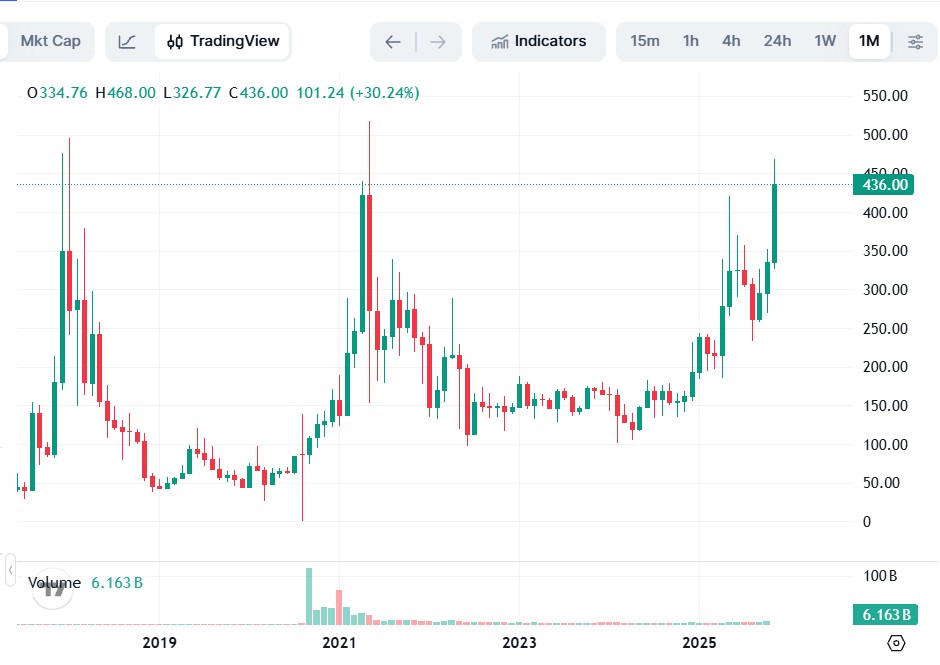
Part of the resurgence seems linked to a renewed debate around tracing, data retention and compliance across exchanges — issues that tend to push some traders toward networks where transactions are harder to map. Monero, which uses ring signatures and stealth addresses as part of its default design, continues to be the outlier in an industry trending toward traceable, regulator-friendly architecture. “You always see this bid pick up when user privacy becomes a headline,” one analyst said, noting chatter about upcoming AML discussions in both Europe and the U.S.
Read more: Is Monero Crypto (XMR) the Last Real Crypto? Why Fans Are Calling It Bitcoin’s Shadow Twin
A few on-chain indicators also showed activity picking up. Monero’s chain doesn’t offer the same transparency as Bitcoin or Ethereum, so analysts rely on proxies like exchange flows and mining chatter. Several mining-focused Telegram groups reported growing interest over the past week after the network implemented another anti-ASIC tweak. That change, although minor, reinforced Monero’s long-running pitch of resisting hardware centralization — a point miners care about, especially as other PoW networks consolidate around industrial players.
Still, not everyone sees the move as the start of a bigger shift. One derivatives trader, who asked not to be named because they’re not authorized to speak publicly, said the rally “feels flow-driven rather than narrative-driven,” adding that next resistance around the $440 area may determine whether this turns into a trend. Liquidity remains patchy given Monero’s delisting history in several jurisdictions, and that alone keeps some funds sidelined.
Regulation remains the big question mark. Authorities in multiple countries have limited or discouraged privacy coins, often citing AML and counter-terror finance concerns. Industry lawyers expect this year to bring fresh discussions about how exchanges handle assets like XMR. Some observers say additional scrutiny could cap upside; others argue that every new restriction strengthens the privacy-value proposition, creating a paradox that long predates the latest rally.
For now, traders appear more curious than committed. A few desks reported inbound interest from clients wanting to “revisit the privacy bucket,” but the scale looks moderate. Technical indicators point to support in the $380–$400 region if the move reverses, though the asset’s structure often makes short-term predictions unreliable.
Whether Monero holds above the $420 level will depend less on chart patterns and more on how the regulatory conversation evolves in the coming weeks. The asset is moving — but its direction will likely be dictated by decisions unfolding far from the charts.
Stay informed with daily updates from Blockchain Magazine on Google News. Click here to follow us and mark as favorite: [Blockchain Magazine on Google News].
Disclaimer: Any post shared by a third-party agency are sponsored and Blockchain Magazine has no views on any such posts. The views and opinions expressed in this post are those of the clients and do not necessarily reflect the official policy or position of Blockchain Magazine. The information provided in this post is for informational purposes only and should not be considered as financial, investment, or professional advice. Blockchain Magazine does not endorse or promote any specific products, services, or companies mentioned in this posts. Readers are encouraged to conduct their own research and consult with a qualified professional before making any financial decisions.
About the Author: Diana Ambolis

