Avalanche DEX trading volume fell 65.24% over 30 days to July 13, 2026, while USDT supply on the chain declined only 19.38% from $412.57M to $332.60M.
Key takeaways
- Avalanche DEX trading volume fell 65.24% over 30 days to July 13, 2026, while USDT supply on the chain declined only 19.38% from $412.57M to $332.60M.
- Avalanche had $1.86B in total USD-pegged stablecoins circulating against just $20.14M in 24-hour DEX volume as of July 13, 2026.
- USDT supply on Avalanche represents $332.60M or 0.18% of the $184.27B in total USDT circulation globally as of July 13, 2026.
Trading Activity Craters Far Faster Than Stablecoin Capital Leaves Avalanche
Read the two decay rates side by side and the story writes itself. Over the 30 days to July 13, 2026, DEX trading volume on Avalanche collapsed 65.24%. USDT circulating supply on the same chain slipped just 19.38%, from $412.57M to $332.60M. Trading has retreated more than three times as fast as the chain’s dominant stablecoin. The read: active traders have largely stepped away, but a meaningful stock of dollar-denominated capital has not yet followed them out.
These two metrics answer different questions. Volume tells you what participants are doing today; stablecoin balances tell you what capital is parked and available. When one falls 65% and the other 19%, the chain is holding a residual capital base that simply isn’t rotating through its trading venues. As of July 13, total stablecoin supply across all USD-pegged assets on Avalanche stands at $1.86B against a 24-hour DEX volume of just $20.14M. That works out to roughly $92 in stablecoins sitting on-chain for every $1 traded in a day, a gap that shows how far activity has lagged committed capital.
Zoom out to the broader on-chain economy and the same asymmetry holds. Avalanche captured 0.36% of all on-chain DEX volume over the prior 24 hours, $20.14M of a $5.59B total, while its USDT supply represents 0.18% of the $184.27B in USDT circulating globally. The chain’s trading share is twice its USDT share, yet both stay small. The faster erosion in volume says Avalanche’s competitive position in active trading is deteriorating quicker than its role as a stablecoin custodian.
DeFi total value locked on Avalanche stood at $459.71M on July 13, well under the $1.86B in stablecoins circulating on the chain. A large share of on-chain dollar liquidity, in other words, is not deployed into yield-bearing or liquidity protocols. Present, but inactive.
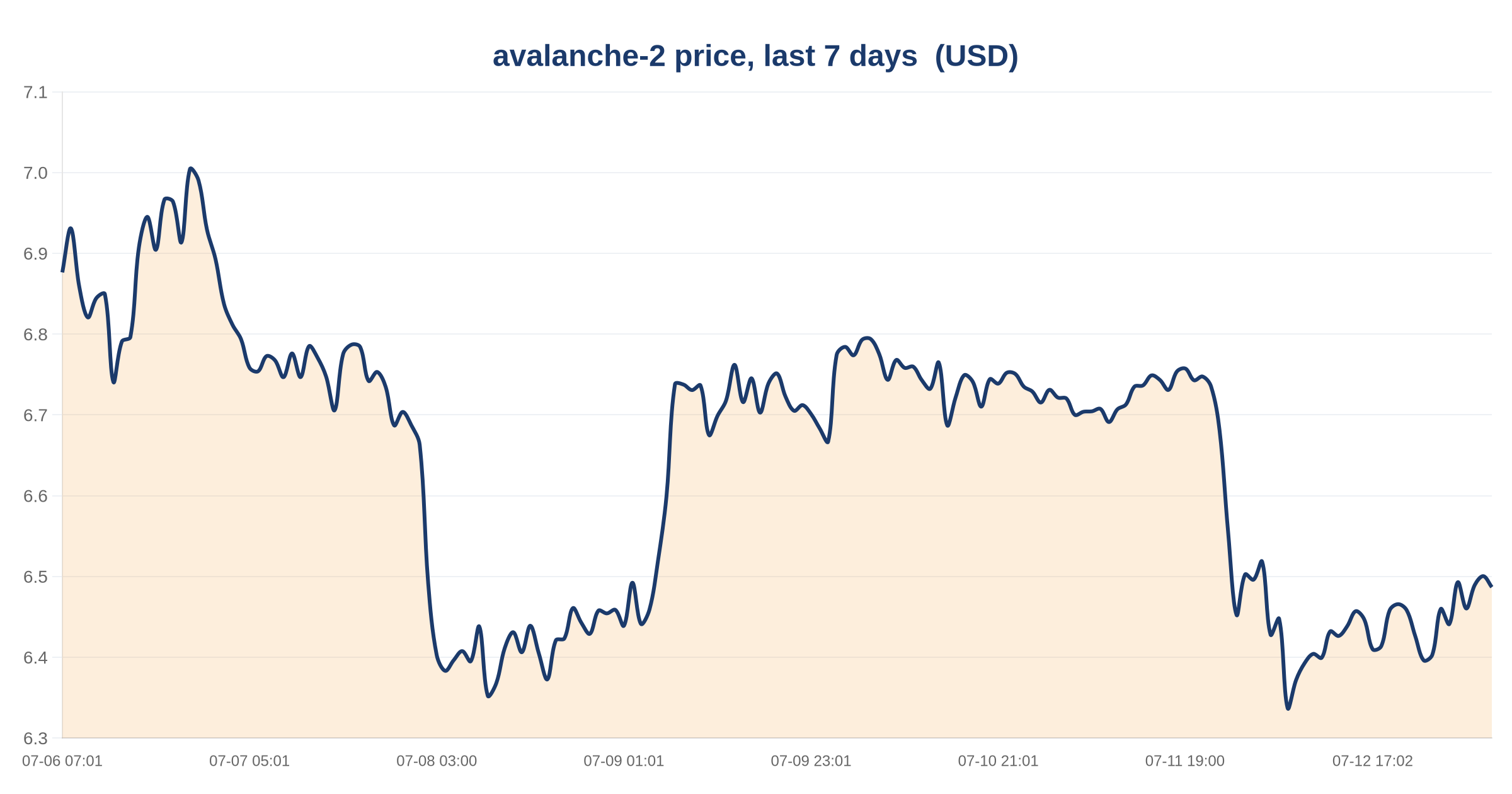
AVAX itself traded at $6.49 with a market capitalization of $2.80B on July 13, up a modest 1.82% over 24 hours. That market cap runs roughly six times the chain’s DeFi TVL of $459.71M.
Why It Matters
- A 65.24% drop in DEX volume against a 19.38% USDT decline signals that trading has contracted far more severely than capital has exited. Activity and liquidity are diverging, not moving in lockstep.
- With $1.86B in stablecoins on-chain but only $20.14M in daily DEX turnover, the dollar liquidity that remains is generating very little on-chain activity, which raises questions about how productive that capital is.
- USDT’s slide from $412.57M to $332.60M over 30 days shows stablecoin holders are also trimming exposure, only at a slower pace. Both metrics point the same direction; magnitude is the difference.
Disclaimer: Market data is informational only and not investment advice. Figures are accurate as of the stated dates and change continuously.
Featured illustration is AI-generated.
Frequently Asked Questions
Why is Avalanche DEX volume falling faster than stablecoin supply?
DEX trading volume on Avalanche fell 65.24% over 30 days while USDT supply declined only 19.38%, indicating that active traders have largely stepped away but capital denominated in dollars has remained on the chain without being actively traded.
How much stablecoin capital is sitting idle on Avalanche?
As of July 13, 2026, Avalanche had $1.86B in total USD-pegged stablecoins circulating against just $20.14M in 24-hour DEX volume, meaning approximately $92 in stablecoins sit on-chain for every $1 traded daily.
What is USDT’s share of Avalanche’s stablecoin supply?
USDT circulating supply on Avalanche is $332.60M as of July 13, 2026, representing 0.18% of the $184.27B in total USDT in global circulation.
Data & sources
Every figure in this article is pulled from live on-chain data and linked to its source and the date it was read.
- DEX volume (24h): $20.14M (as of 2026-07-13) — source [API]
- DEX volume 30-day change: -65.24% (as of 2026-07-13) — source [API]
- Share of all DEX volume: +0.36% (as of 2026-07-13) — source [API]
- DeFi TVL: $459.71M (as of 2026-07-13) — source [API]
- Total stablecoin supply on chain: $1.86B (as of 2026-07-13) — source [API]
- Stablecoin supply on chain: $332.60M (as of 2026-07-13) — source [API]
- Stablecoin 30-day supply change: -19.38% (as of 2026-07-13) — source [API]
- Stablecoin chain share: +0.18% (as of 2026-07-13) — source [API]
- Price: $6.49 (as of 2026-07-13) — source [API]
- 24-hour price change: +1.82% (as of 2026-07-13) — source [API]
Methodology: every figure above links to its live on-chain source (DeFiLlama, CoinGecko) and the date it was read; analysis by Blockchain Magazine. Informational only, not investment advice.
Related analysis
Stay informed with daily updates from Blockchain Magazine on Google News. Click here to follow us and mark as favorite: [Blockchain Magazine on Google News].
Disclaimer: Any post shared by a third-party agency are sponsored and Blockchain Magazine has no views on any such posts. The views and opinions expressed in this post are those of the clients and do not necessarily reflect the official policy or position of Blockchain Magazine. The information provided in this post is for informational purposes only and should not be considered as financial, investment, or professional advice. Blockchain Magazine does not endorse or promote any specific products, services, or companies mentioned in this posts. Readers are encouraged to conduct their own research and consult with a qualified professional before making any financial decisions.
About the Author: John Brok