Ethereum DeFi total value locked (TVL) increased 6.44% to $39.95B over 30 days ending July 13, 2026, while DEX trading volume fell 36.99% to $652.32M in 24 hours.
Key takeaways
- Ethereum DeFi total value locked (TVL) increased 6.44% to $39.95B over 30 days ending July 13, 2026, while DEX trading volume fell 36.99% to $652.32M in 24 hours.
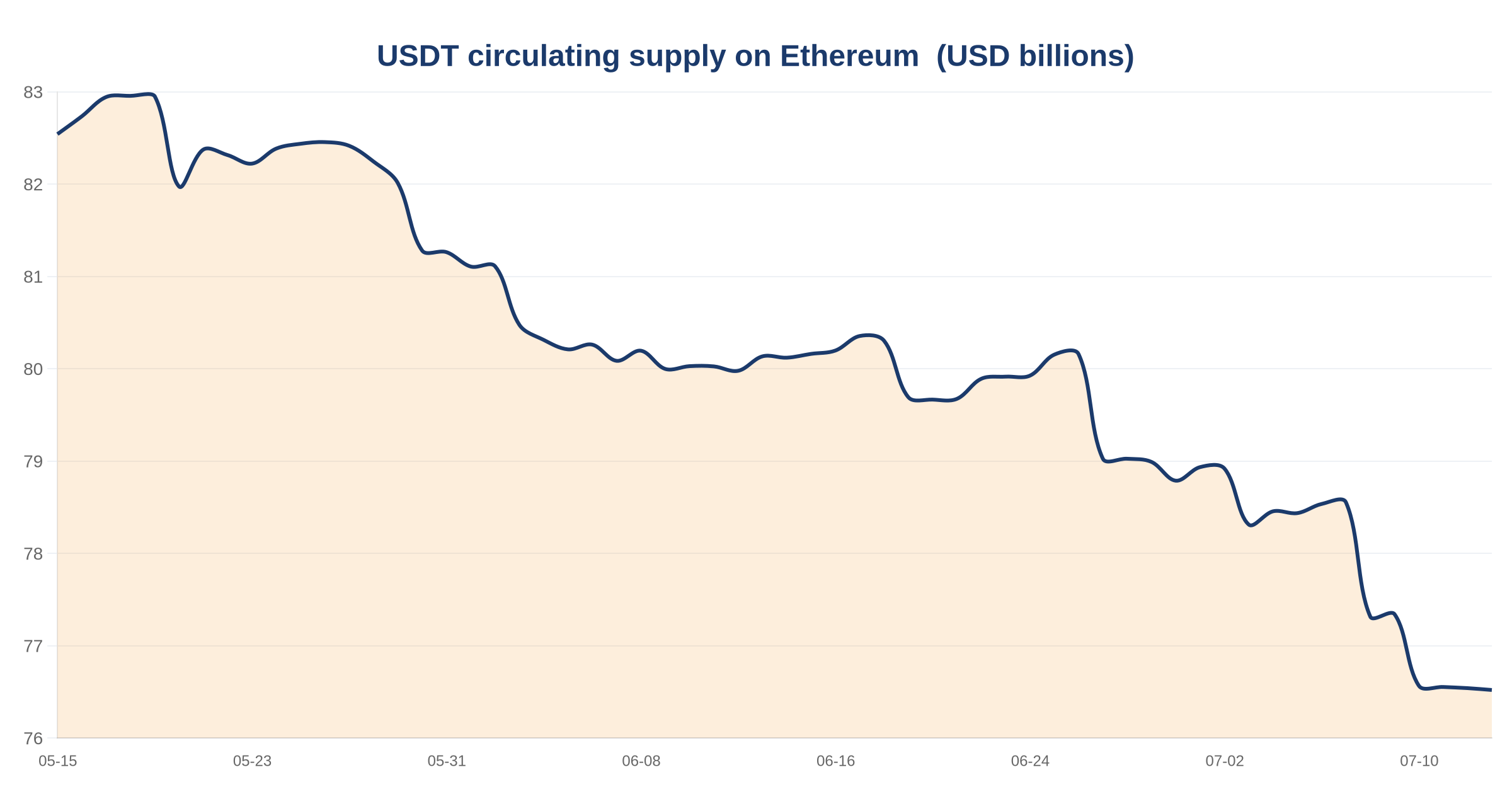
- USDT supply on Ethereum declined 4.51% to $76.52B over the 30-day period ending July 13, 2026, representing 41.53% of all USDT in global circulation.
- Ethereum accounted for 11.68% of all on-chain DEX volume ($652.32M of $5.59B) on July 13, 2026, despite holding a dominant share of locked value and stablecoin supply.
Ethereum’s Locked Capital Grows Even as Stablecoin Supply and Trading Volume Retreat
Two numbers are pulling apart, and that split is the story. Over the 30 days to July 13, 2026, total value locked in Ethereum DeFi climbed 6.44%, from $37.53B to $39.95B, while DEX trading volume on the same chain fell 36.99% to a 24-hour reading of $652.32M. Capital committed to protocols is expanding while capital changing hands contracts. Read together, the deltas point to on-chain dollars settling into locked positions instead of cycling through spot venues.
Layer in stablecoin supply and the read sharpens. Ethereum’s total USD-pegged stablecoin supply sits at $150.64B, and its two biggest components are both shrinking: USDT fell 4.51% over the trailing 30 days, from $80.13B to $76.52B, and USDC dropped 2.12% over the same window, from $47.90B to $46.89B. So the stablecoin pool is contracting as DEX volume falls, which means that 6.44% TVL gain is a larger slice of a smaller pie. The dollars that stayed on Ethereum are rotating toward protocol deposits, not active trading.
Ethereum’s slice of the wider DEX market backs up the volume trend. Its $652.32M in 24-hour turnover sits against a $5.59B cross-chain total, leaving Ethereum at 11.68% of all on-chain DEX activity on July 13. That is less than one-eighth of the global decentralized trading market: spot flow has moved to competing chains even as Ethereum keeps the dominant share of locked value.
On stablecoins, the network’s relative footing stays heavy despite the outflows. Ethereum’s $76.52B of USDT is 41.53% of all USDT in circulation globally ($184.27B total), and its $46.89B of USDC is 63.83% of all USDC in circulation ($73.46B total). Ethereum still anchors the largest dollar reserves on-chain, yet the 30-day direction in both assets points outward.
Why It Matters
- TVL and volume are diverging, not converging. A 6.44% rise in locked capital against a 36.99% drop in trading volume says the marginal on-chain dollar is picking protocol deposits over spot trading, a structural shift in how Ethereum’s liquidity is deployed.
- Stablecoin outflows are real but selective. USDT’s 30-day decline of $3.61B on Ethereum runs proportionally larger than USDC’s $1.01B drop, yet Ethereum still holds nearly two-thirds of all circulating USDC. Dollar liquidity is contracting without loosening the chain’s grip.
- DEX market share signals competitive pressure. Capturing 11.68% of global DEX volume while holding a far larger share of TVL and stablecoin supply means trading activity is leaving Ethereum faster than committed capital is. Watch that gap across the next 30-day windows.
Disclaimer: Market data is informational only and not investment advice. Figures are accurate as of the stated dates and change continuously.
Featured illustration is AI-generated.
Frequently Asked Questions
Why is Ethereum’s DeFi TVL growing while DEX trading volume is falling?
DeFi total value locked increased 6.44% to $39.95B over 30 days ending July 13, 2026, while DEX trading volume fell 36.99% to $652.32M in 24 hours, indicating that on-chain capital is rotating toward protocol deposits rather than active spot trading.
What happened to stablecoin supplies on Ethereum?
USDT supply on Ethereum declined 4.51% to $76.52B over the 30-day period ending July 13, 2026, and USDC dropped 2.12% to $46.89B over the same window, with both assets representing a contraction in Ethereum’s dollar-pegged reserves.
How much of the global DEX market does Ethereum control?
Ethereum accounted for 11.68% of all on-chain DEX volume ($652.32M of $5.59B) on July 13, 2026, despite holding a dominant share of total value locked and stablecoin supply.
Data & sources
Every figure in this article is pulled from live on-chain data and linked to its source and the date it was read.
- Total stablecoin supply on chain: $150.64B (as of 2026-07-13) — source [API]
- DeFi TVL: $39.95B (as of 2026-07-13) — source [API]
- DeFi TVL 30-day change: +6.44% (as of 2026-07-13) — source [API]
- DEX volume (24h): $652.32M (as of 2026-07-13) — source [API]
- DEX volume 30-day change: -36.99% (as of 2026-07-13) — source [API]
- Share of all DEX volume: +11.68% (as of 2026-07-13) — source [API]
- Stablecoin supply on chain: $76.52B (as of 2026-07-13) — source [API]
- Stablecoin 30-day supply change: -4.51% (as of 2026-07-13) — source [API]
- Stablecoin chain share: +41.53% (as of 2026-07-13) — source [API]
- Stablecoin supply on chain: $46.89B (as of 2026-07-13) — source [API]
- Stablecoin 30-day supply change: -2.12% (as of 2026-07-13) — source [API]
- Stablecoin chain share: +63.83% (as of 2026-07-13) — source [API]
Methodology: every figure above links to its live on-chain source (DeFiLlama, CoinGecko) and the date it was read; analysis by Blockchain Magazine. Informational only, not investment advice.
Related analysis
Stay informed with daily updates from Blockchain Magazine on Google News. Click here to follow us and mark as favorite: [Blockchain Magazine on Google News].
Disclaimer: Any post shared by a third-party agency are sponsored and Blockchain Magazine has no views on any such posts. The views and opinions expressed in this post are those of the clients and do not necessarily reflect the official policy or position of Blockchain Magazine. The information provided in this post is for informational purposes only and should not be considered as financial, investment, or professional advice. Blockchain Magazine does not endorse or promote any specific products, services, or companies mentioned in this posts. Readers are encouraged to conduct their own research and consult with a qualified professional before making any financial decisions.
About the Author: John Brok