Ethereum DeFi total value locked (TVL) rose 4.11% over 30 days to $41.54B as of August 6, 2026, while decentralized exchange volume fell 13.30% to $1.01B in the same period.
Key takeaways
- Ethereum DeFi total value locked (TVL) rose 4.11% over 30 days to $41.54B as of August 6, 2026, while decentralized exchange volume fell 13.30% to $1.01B in the same period.
- Ethereum accounted for 13.70% of all on-chain DEX volume ($1.01B of $7.36B globally) over the last 24 hours as of August 6, 2026.
- USDT circulating supply on Ethereum declined 4.77% over the past 30 days to $74.81B, representing 40.76% of the $183.52B in total USDT circulation globally.
Ethereum TVL Climbs as DEX Volume Retreats, Exposing a Capital-Activity Split
Forget the price for a moment. The story in Ethereum’s on-chain data on August 6, 2026, sits in the gap between money committed and money moving. Total value locked in Ethereum DeFi rose 4.11% over the trailing 30 days, from $39.90B to $41.54B, while decentralized exchange volume on the same network fell 13.30% across that window. Capital keeps flowing into the protocol layer. The trading that usually rides alongside it does not.
Read that divergence plainly: assets are being deposited and held in lending markets, liquidity pools, and yield-bearing vaults, not cycled through spot and swap venues. The $41.54B in TVL is locked, committed capital; the $1.01B in 24-hour DEX volume is the slice actually being traded on a given day. Volume is contracting at more than three times the rate TVL is growing, which tilts the balance further toward parked capital.
Ethereum’s place in the multi-chain DEX market sharpens the read. That $1.01B in 24-hour volume is 13.70% of the $7.36B transacted across all chains in the same window, leaving roughly $6.35B in swap activity, more than six times Ethereum’s figure, happening elsewhere. Deep capital commitment on-chain, a minority claim on where trading actually lands: the two metrics are running on separate tracks.
Stablecoins add a layer. USD-pegged stablecoins on Ethereum total $146.70B in circulating supply, a large reservoir of dollar liquidity. USDT is the biggest single piece at $74.81B, and it has contracted 4.77% over the past 30 days, down from $78.55B on July 7, 2026. Ethereum still hosts 40.76% of all USDT in circulation, $74.81B of $183.52B globally, but that share is being trimmed as supply migrates or is redeemed. A shrinking USDT base against rising TVL points to a simple conclusion: fresh Tether issuance on Ethereum is not what’s driving deposits into DeFi. Other assets or stablecoin types inside the $146.70B total are carrying that weight.
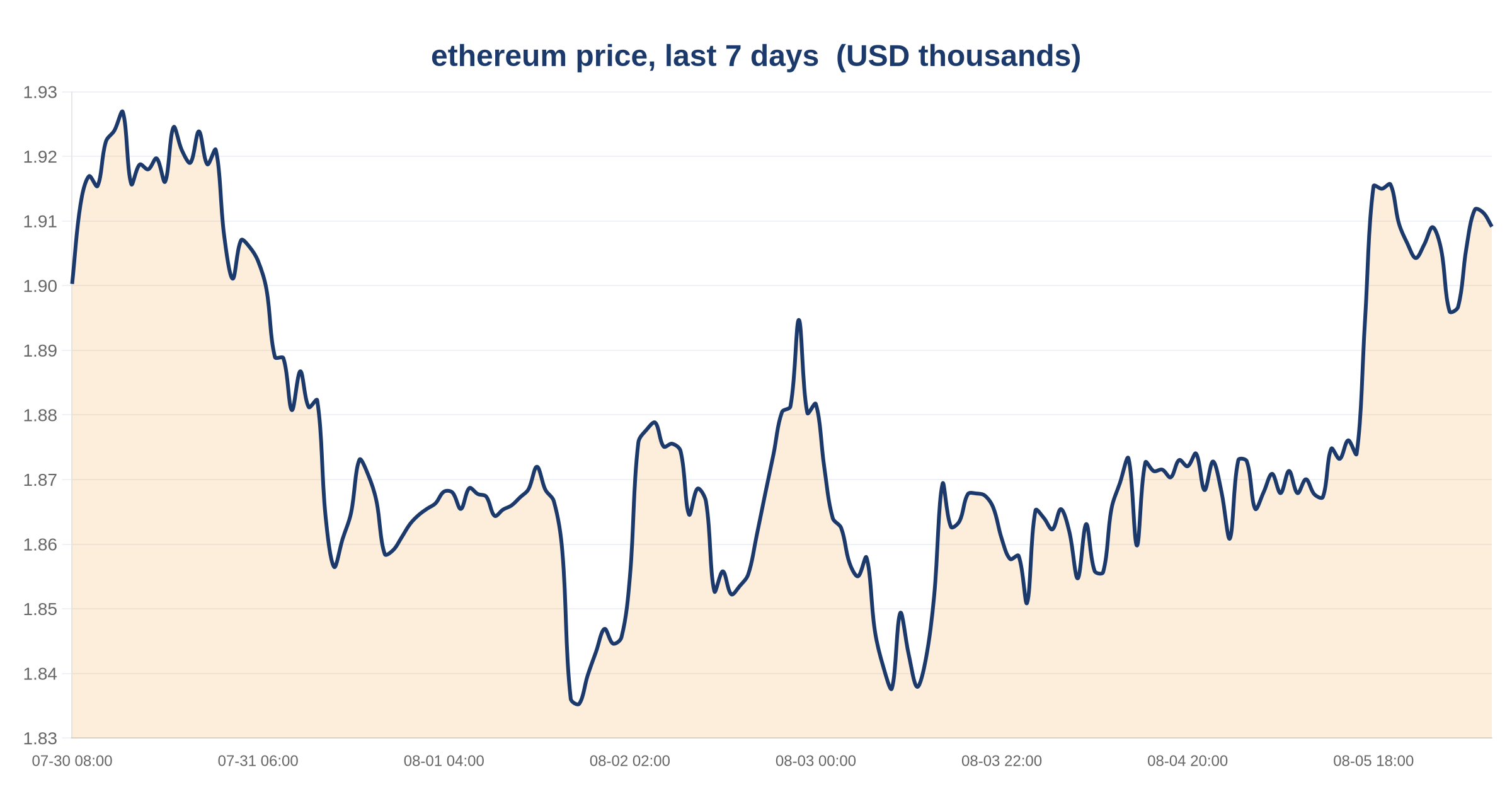
ETH itself trades at $1,908.36, a $230.31B market cap, up 2.07% on the day. Modest, and consistent with everything above. Not a rally, not a collapse, but a network in consolidation where holders are committing capital to protocols rather than rotating hard through exchanges.
Why It Matters
- TVL growing while DEX volume shrinks marks Ethereum functioning more as a capital repository than an active trading venue this period, with direct consequences for fee generation and protocol revenue.
- Holding only 13.70% of all-chain DEX volume against $41.54B in locked capital shows trading has migrated to competing networks, even as Ethereum stays the primary home for long-duration DeFi deposits.
- USDT’s 4.77% 30-day decline on Ethereum, set against a $146.70B total stablecoin base, points to more diversified dollar liquidity, and to one of the network’s largest liquidity anchors quietly shrinking.
Disclaimer: Market data is informational only and not investment advice. Figures are accurate as of the stated dates and change continuously.
Frequently Asked Questions
Why is Ethereum’s TVL rising while DEX trading volume is falling?
Assets are being deposited and held in lending markets, liquidity pools, and yield-bearing vaults rather than being cycled through spot and swap venues. This indicates capital is being committed to protocols for longer-duration positions rather than actively traded on decentralized exchanges.
What share of global DEX volume does Ethereum handle?
Ethereum accounted for 13.70% of all on-chain DEX volume over the last 24 hours as of August 6, 2026, with $1.01B of the $7.36B transacted globally, leaving roughly six times that amount in swap activity happening on other chains.
Is USDT growth driving the increase in Ethereum DeFi deposits?
No—USDT on Ethereum declined 4.77% over the past 30 days to $74.81B, while DeFi TVL rose 4.11%, indicating that fresh Tether issuance is not driving the deposit growth and other assets or stablecoin types are carrying that weight.
Data & sources
Every figure in this article is pulled from live on-chain data and linked to its source and the date it was read.
- Price: $1.91K (as of 2026-08-06) — source [API]
- 24-hour price change: +2.07% (as of 2026-08-06) — source [API]
- DeFi TVL: $41.54B (as of 2026-08-06) — source [API]
- DeFi TVL 30-day change: +4.11% (as of 2026-08-06) — source [API]
- DEX volume (24h): $1.01B (as of 2026-08-06) — source [API]
- DEX volume 30-day change: -13.30% (as of 2026-08-06) — source [API]
- Share of all DEX volume: +13.70% (as of 2026-08-06) — source [API]
- Total stablecoin supply on chain: $146.70B (as of 2026-08-06) — source [API]
- Stablecoin supply on chain: $74.81B (as of 2026-08-06) — source [API]
- Stablecoin 30-day supply change: -4.77% (as of 2026-08-06) — source [API]
- Stablecoin chain share: +40.76% (as of 2026-08-06) — source [API]
Methodology: every figure above links to its live on-chain source (DeFiLlama, CoinGecko) and the date it was read; analysis by Blockchain Magazine. Informational only, not investment advice.
Related analysis
Stay informed with daily updates from Blockchain Magazine on Google News. Click here to follow us and mark as favorite: [Blockchain Magazine on Google News].
Disclaimer: Any post shared by a third-party agency are sponsored and Blockchain Magazine has no views on any such posts. The views and opinions expressed in this post are those of the clients and do not necessarily reflect the official policy or position of Blockchain Magazine. The information provided in this post is for informational purposes only and should not be considered as financial, investment, or professional advice. Blockchain Magazine does not endorse or promote any specific products, services, or companies mentioned in this posts. Readers are encouraged to conduct their own research and consult with a qualified professional before making any financial decisions.
About the Author: John Brok