BSC’s total value locked stands at $5.29B as of October 30, 2026, down 6.74% over the trailing 30 days from $5.67B.
Key takeaways
- BSC’s total value locked stands at $5.29B as of October 30, 2026, down 6.74% over the trailing 30 days from $5.67B.
- DEX trading volume on BSC reached $1.51B in the last 24 hours as of October 30, 2026, up 44.40% over the trailing 30 days.
- BSC accounted for 9.47% of all on-chain DEX volume ($1.51B of $15.96B globally) in the last 24 hours as of October 30, 2026.
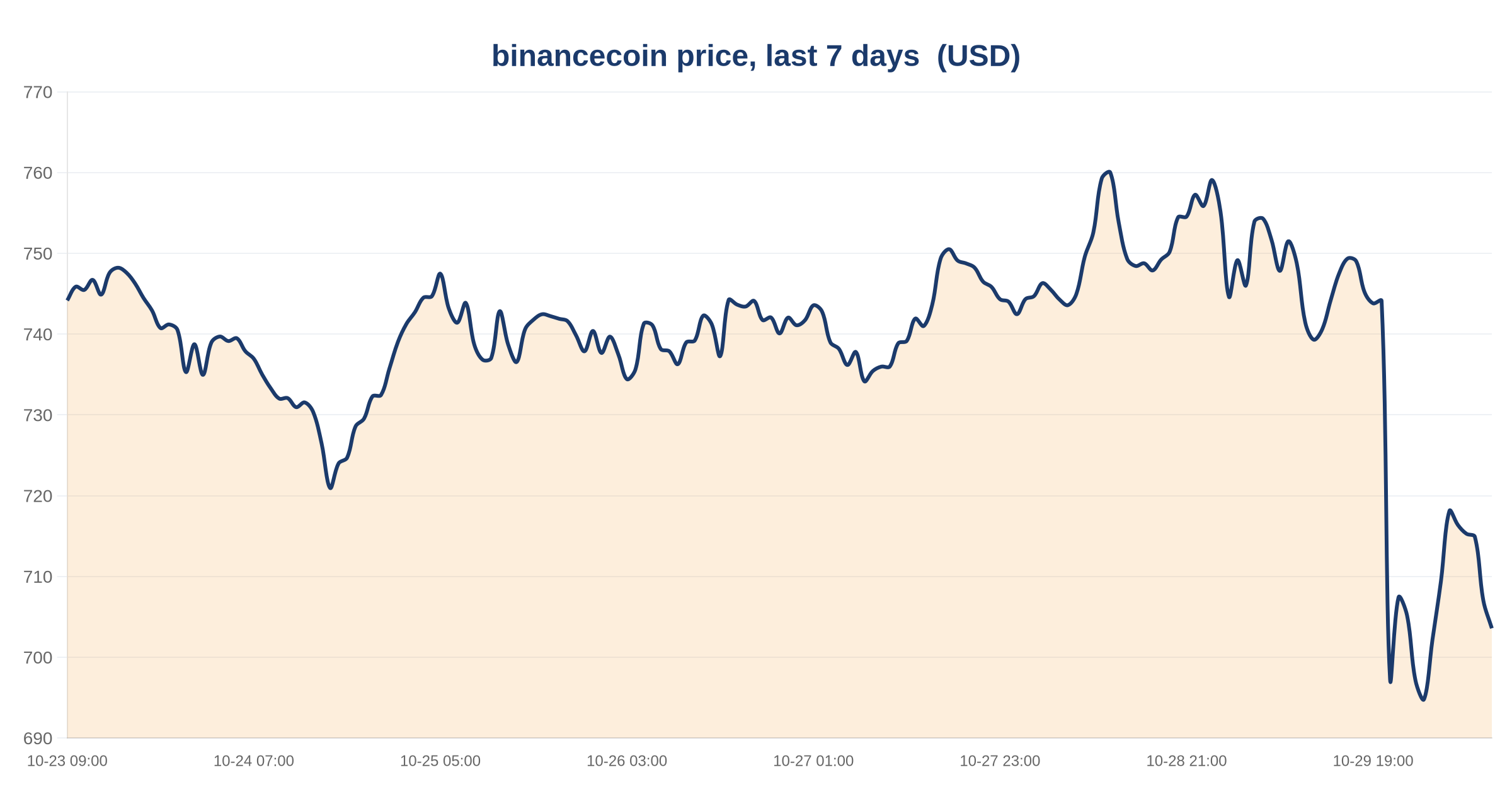
- BINANCECOIN traded at $703.31 with a market capitalization of $92.69B and declined 6.53% over the prior 24 hours as of October 30, 2026.
| Metric | Value | As of | Source |
|---|---|---|---|
| DeFi TVL | $5.29B | 2026-10-30 | source |
| DeFi TVL 30-day change | -6.74% | 2026-10-30 | source |
| DEX volume (24h) | $1.51B | 2026-10-30 | source |
| DEX volume 30-day change | +44.40% | 2026-10-30 | source |
| Share of all DEX volume | +9.47% | 2026-10-30 | source |
| Price | $703.31 | 2026-10-30 | source |
| 24-hour price change | -6.53% | 2026-10-30 | source |
BSC’s Trading Surge Runs Counter to Shrinking Locked Capital
Two numbers that usually travel together have split apart on BSC, and the gap is the whole story. DEX volume is up +44.40% over the trailing 30 days while total value locked has gone the other way, down -6.74% from $5.67B to $5.29B. Read plainly: trades are accelerating on a shrinking base of committed capital, so every dollar locked is now clearing far more volume than it was a month ago. For anyone weighing whether BSC’s activity reflects broad demand or something narrower, that divergence is where the answer lives.
The 24-hour snapshot sharpens it. BSC venues cleared $1.51B in DEX volume in a single day as of 30 October 2026, which is 9.47% of the $15.96B in on-chain DEX volume logged across all chains in that window. Nearly one in ten dollars of global decentralized exchange flow ran through BSC.
Set that against the $5.29B TVL figure and the tension is obvious. Depositors and liquidity providers were net withdrawers this past month, not net additions, so the volume surge is turnover of existing liquidity rather than fresh money arriving. That can mean liquidity is being put to work efficiently. It can just as easily mean pools are being pressed harder as their depth thins, a condition that tends to widen slippage on larger trades.
BINANCECOIN complicates the read. The asset trades at $703.31 on a market capitalization of $92.69B as of 30 October 2026, yet it fell -6.53% in the prior 24 hours. A sharp single-day drop in the chain’s primary asset, landing on the same day BSC commands nearly 9.5% of global DEX volume, suggests at least part of that elevated activity is volatility-driven flow. When an asset slides, short-term traders and arbitrageurs manufacture volume; those prints flatter the activity metrics without proving new users or deeper liquidity showed up.
Why It Matters
- Volume-to-TVL divergence is a leading stress indicator. A 30-day TVL decline of $380M against a +44.40% volume increase means daily volume relative to locked capital has expanded sharply. Anyone depending on deep liquidity for size should factor in the thinning.
- Chain-share context matters. BSC’s 9.47% of global DEX volume in one day is a measurable position in the on-chain market, not a label dressed up as one.
- Asset and chain metrics can diverge. BINANCECOIN’s -6.53% daily move alongside heavy BSC volume shows high activity doesn’t automatically carry the underlying asset’s price, and the reverse holds too.
BSC as of 30 October 2026 is a chain producing heavy trading flow on a capital base that has been contracting for a month. The trend to watch is which side resolves first: TVL recovering toward the volume, or volume normalizing back toward the $5.29B that’s actually locked.
Disclaimer: Market data is informational only and not investment advice. Figures are accurate as of the stated dates and change continuously.
Frequently Asked Questions
What is the current total value locked on BSC?
BSC’s total value locked stands at $5.29B as of October 30, 2026, down 6.74% over the trailing 30 days from $5.67B.
How much DEX trading volume did BSC handle recently?
DEX trading volume on BSC reached $1.51B in the last 24 hours as of October 30, 2026, representing 9.47% of all on-chain DEX volume globally ($15.96B total).
Why is BSC’s volume rising while locked capital is falling?
DEX volume is up 44.40% over the trailing 30 days while TVL has declined 6.74%, meaning trades are accelerating on a shrinking base of committed capital; depositors were net withdrawers this past month, so the volume surge reflects turnover of existing liquidity rather than fresh money arriving.
What does the divergence between BSC’s volume and TVL indicate?
The volume-to-TVL divergence is a leading stress indicator showing that liquidity is either being put to work efficiently or pools are being pressed harder as their depth thins, which can widen slippage on larger trades.
Related analysis
Data & sources
Every figure in this article is pulled from live on-chain data and linked to its source and the date it was read.
- DeFi TVL: $5.29B (as of 2026-10-30) — source [API]
- DeFi TVL 30-day change: -6.74% (as of 2026-10-30) — source [API]
- DEX volume (24h): $1.51B (as of 2026-10-30) — source [API]
- DEX volume 30-day change: +44.40% (as of 2026-10-30) — source [API]
- Share of all DEX volume: +9.47% (as of 2026-10-30) — source [API]
- Price: $703.31 (as of 2026-10-30) — source [API]
- 24-hour price change: -6.53% (as of 2026-10-30) — source [API]
Methodology: every figure above links to its live on-chain source (DeFiLlama, CoinGecko) and the date it was read; analysis by Blockchain Magazine. Informational only, not investment advice.
Stay informed with daily updates from Blockchain Magazine on Google News. Click here to follow us and mark as favorite: [Blockchain Magazine on Google News].
Disclaimer: Any post shared by a third-party agency are sponsored and Blockchain Magazine has no views on any such posts. The views and opinions expressed in this post are those of the clients and do not necessarily reflect the official policy or position of Blockchain Magazine. The information provided in this post is for informational purposes only and should not be considered as financial, investment, or professional advice. Blockchain Magazine does not endorse or promote any specific products, services, or companies mentioned in this posts. Readers are encouraged to conduct their own research and consult with a qualified professional before making any financial decisions.
About the Author: John Brok