Total value locked in Ethereum’s DeFi ecosystem reached $41.84B as of August 8, 2026, up 7.82% over the trailing 30 days.
Key takeaways
- Total value locked in Ethereum’s DeFi ecosystem reached $41.84B as of August 8, 2026, up 7.82% over the trailing 30 days.
- Ethereum’s decentralized exchange volume fell 36.13% over the same 30-day period despite TVL growth, declining from higher trading activity.
- Ethereum accounted for $1.02B in DEX trading volume over 24 hours on August 8, 2026, representing 15.50% of all on-chain DEX volume across all blockchains.
Capital Deepens on Ethereum’s DeFi Layer Even as Trading Activity Retreats
Two numbers are pulling apart, and that gap is the story. Total value locked in Ethereum’s DeFi ecosystem has climbed 7.82% over the trailing 30 days, from $38.81B to $41.84B as of August 8, 2026. Decentralized exchange volume on the network fell 36.13% across that same window. Committed capital is growing while the trading that runs on top of it is shrinking, and the honest read is a DeFi base that’s deepening rather than churning.
Follow the mechanics. A larger pool of locked capital is now generating proportionally less trading throughput. The $41.84B sitting in Ethereum’s protocols isn’t cycling through swaps: it reads as capital parked in longer-duration positions like lending markets and liquidity vaults, not money moving through exchanges at an elevated rate.
The volume picture has a second layer worth pulling out. Ethereum’s $1.02B in 24-hour DEX volume on August 8 was just 15.50% of the $6.56B traded across all chains that day. So the network holding $41.84B in locked capital, the dominant store of DeFi value, accounts for less than one-sixth of on-chain trading industry-wide. Settlement and swap activity have spread to other networks even as Ethereum keeps the larger share of committed capital.
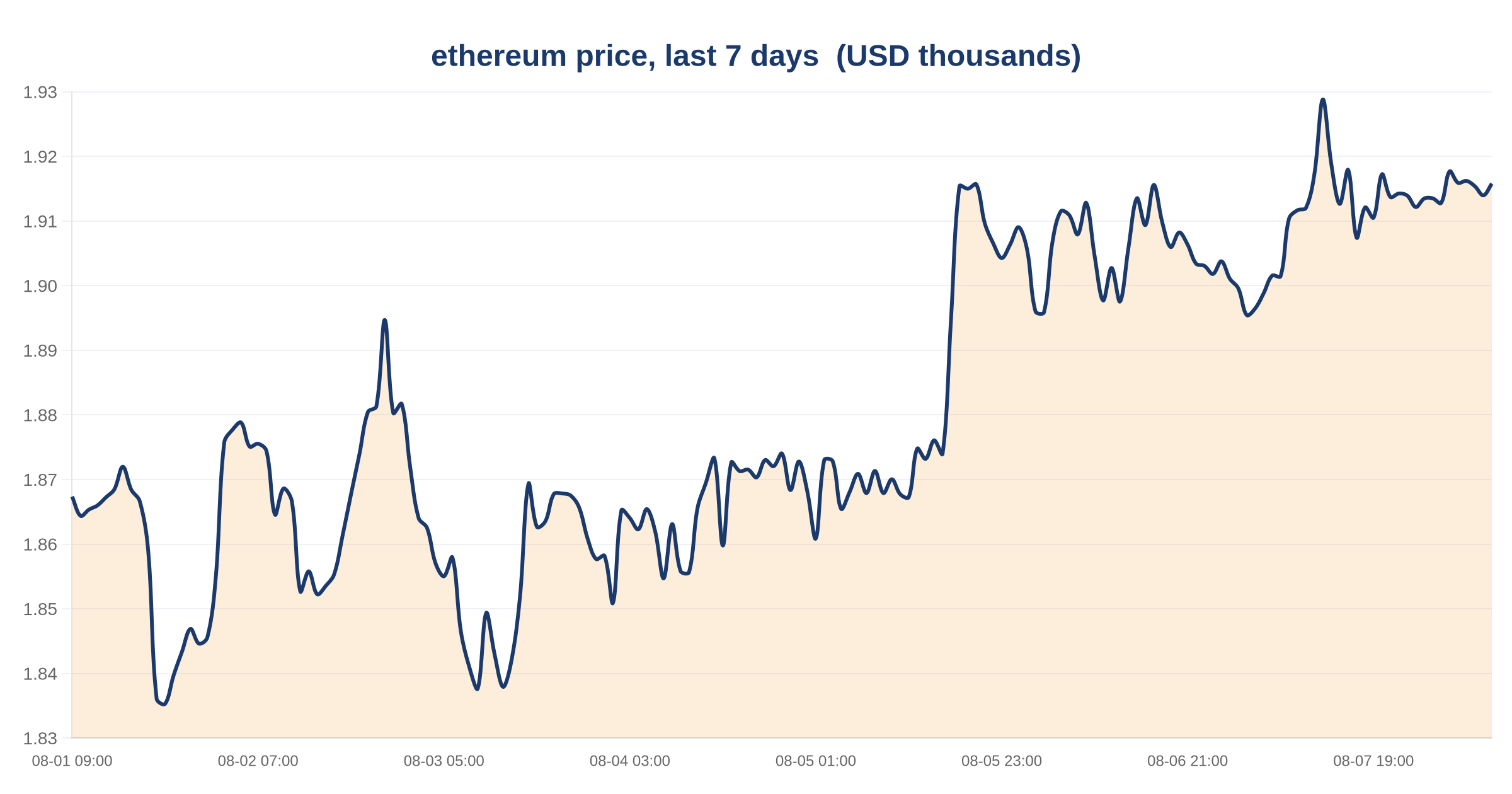
ETH itself traded at $1,915.84 on August 8, with a market capitalization of $231.21B and a 24-hour move of +0.29%. That near-flat price fits the on-chain data. No surge of speculative trading, no sharp outflow of locked capital, is showing up in the numbers.
Why It Matters
- TVL growth without volume growth suggests capital consolidation, not speculation. A 7.82% rise in locked value against a 36.13% drop in DEX volume points to new inflows settling into yield-bearing or collateral positions rather than driving active trading.
- Ethereum’s share of on-chain volume is narrow relative to its share of locked capital. Holding the capital base while contributing 15.50% of cross-chain DEX volume means trading is proportionally more concentrated on other networks, reflecting where users choose to execute regardless of where their capital sits.
- The near-flat ETH price reinforces the pattern. A +0.29% move in 24 hours against a $231.21B market cap shows no outsized spot pressure either way, consistent with accumulation over activity.
The figures describe an Ethereum DeFi layer growing its balance sheet while transaction-level activity cools. That splits committed capital from active liquidity, and it leaves the open question of where the missing on-chain volume is going across the rest of the multi-chain field.
Disclaimer: Market data is informational only and not investment advice. Figures are accurate as of the stated dates and change continuously.
Frequently Asked Questions
What does the $41.84B in Ethereum DeFi TVL actually tell us?
The $41.84B in total value locked as of August 8, 2026 represents capital parked in longer-duration positions like lending markets and liquidity vaults rather than actively cycling through trades. This growth of 7.82% over 30 days alongside a 36.13% decline in DEX volume suggests capital consolidation and deepening, not speculation.
Why is Ethereum’s DEX volume falling while TVL is rising?
Ethereum’s $1.02B in 24-hour DEX volume fell 36.13% over the trailing 30 days even as TVL grew 7.82%, indicating that new capital inflows are settling into yield-bearing or collateral positions rather than driving active trading activity.
What does Ethereum’s 15.50% share of on-chain DEX volume mean?
Although Ethereum holds the dominant share of DeFi’s locked capital at $41.84B, it accounted for only 15.50% of the $6.56B in total on-chain DEX volume over 24 hours on August 8, 2026, showing that trading activity has become more distributed across other networks despite capital concentration on Ethereum.
Related analysis
Data & sources
Every figure in this article is pulled from live on-chain data and linked to its source and the date it was read.
- DeFi TVL: $41.84B (as of 2026-08-08) — source [API]
- DeFi TVL 30-day change: +7.82% (as of 2026-08-08) — source [API]
- DEX volume (24h): $1.02B (as of 2026-08-08) — source [API]
- DEX volume 30-day change: -36.13% (as of 2026-08-08) — source [API]
- Share of all DEX volume: +15.50% (as of 2026-08-08) — source [API]
- Price: $1.92K (as of 2026-08-08) — source [API]
- 24-hour price change: +0.29% (as of 2026-08-08) — source [API]
Methodology: every figure above links to its live on-chain source (DeFiLlama, CoinGecko) and the date it was read; analysis by Blockchain Magazine. Informational only, not investment advice.
Stay informed with daily updates from Blockchain Magazine on Google News. Click here to follow us and mark as favorite: [Blockchain Magazine on Google News].
Disclaimer: Any post shared by a third-party agency are sponsored and Blockchain Magazine has no views on any such posts. The views and opinions expressed in this post are those of the clients and do not necessarily reflect the official policy or position of Blockchain Magazine. The information provided in this post is for informational purposes only and should not be considered as financial, investment, or professional advice. Blockchain Magazine does not endorse or promote any specific products, services, or companies mentioned in this posts. Readers are encouraged to conduct their own research and consult with a qualified professional before making any financial decisions.
About the Author: John Brok