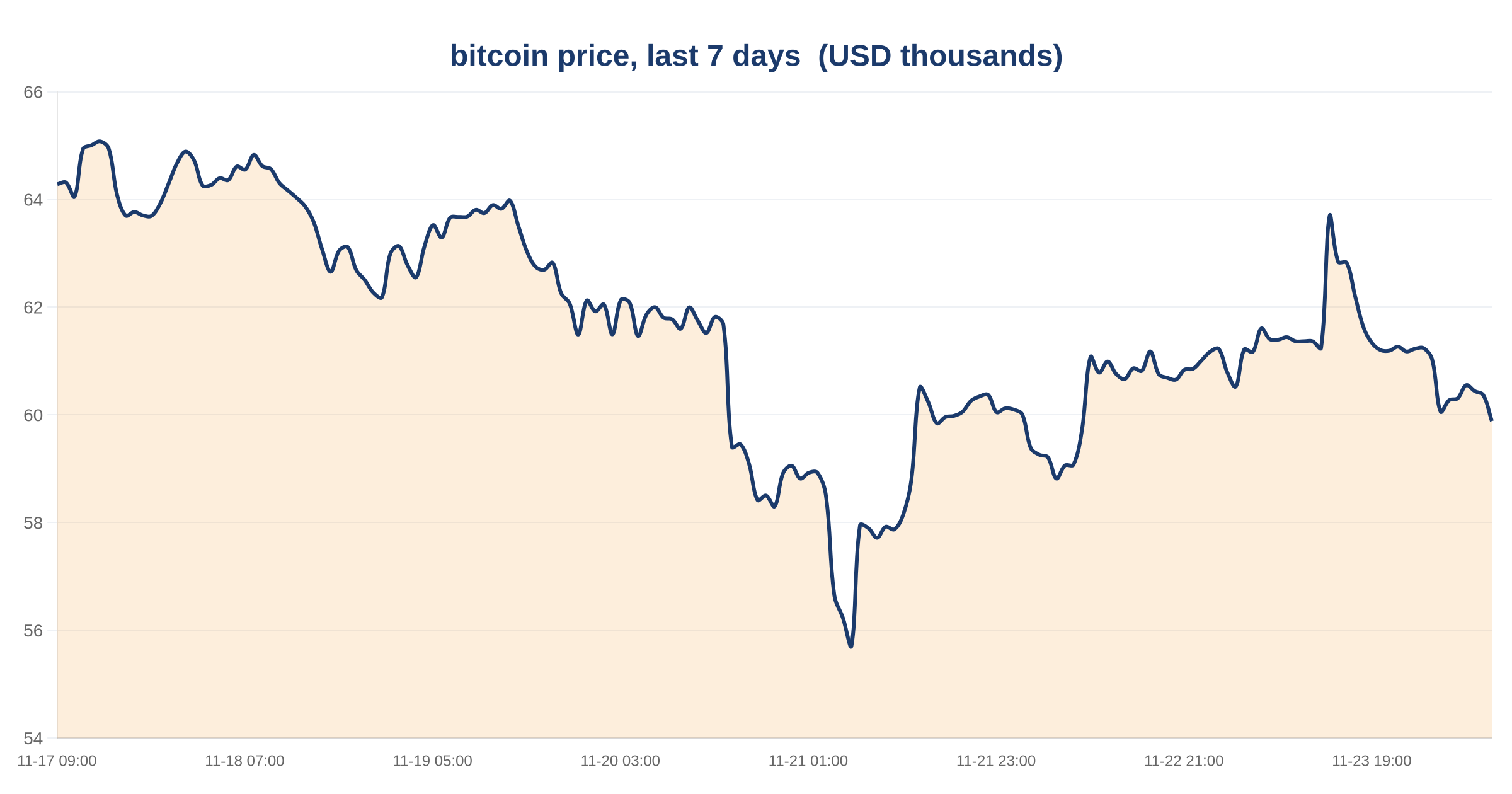
Bitcoin declined 2.54% to $59,921.00 over 24 hours as of 2026-11-24, reducing market capitalization to $1.21 trillion.
Key takeaways
- Bitcoin declined 2.54% to $59,921.00 over 24 hours as of 2026-11-24, reducing market capitalization to $1.21 trillion.
- The Bitcoin network hash rate held steady at 1,146.06 EH/s despite the price drop, with mining difficulty at 1.348×10¹⁴.
- Bitcoin blocks averaged 7.86-minute intervals over the past 24 hours, faster than the protocol’s 10-minute target, signaling a likely difficulty increase at the next adjustment.
- The network processed 484,407 transactions in 24 hours with 20,116,709.375 BTC of the 21,000,000 maximum supply mined as of 2026-11-24.
| Metric | Value | As of | Source |
|---|---|---|---|
| Price | $59.92K | 2026-11-24 | source |
| 24-hour price change | -2.54% | 2026-11-24 | source |
| btc hash rate | 1146.0641112988408 | 2026-11-24 | source |
| btc difficulty | 134823837323272 | 2026-11-24 | source |
| btc tx 24h | 484407 | 2026-11-24 | source |
| btc block time | 7.8647 | 2026-11-24 | source |
| btc supply mined | 20116709.375 | 2026-11-24 | source |
Miners Hold the Line While Price Retreats
Read the 24-hour snapshot carefully and the price drop isn’t the story. The disconnect is. BTC has shed 2.54% over the past 24 hours to $59,921.00, trimming market capitalization to $1.21 trillion, yet the hash rate securing the network reads 1,146.06 EH/s and difficulty holds at 1.348×10¹⁴. Miners haven’t flinched. Dollar-denominated revenue is contracting while the computational intensity behind the chain stays firm, and that gap is the defining feature of this moment.
Block timing sharpens the read. Over the past 24 hours, blocks have arrived every 7.86 minutes on average, measurably inside the protocol’s 10-minute target. Faster blocks mean aggregate hash rate is running ahead of what the current difficulty was calibrated to absorb. Miners are collectively producing more work than the last adjustment anticipated, which points toward a higher threshold at the next recalibration. That cuts against them: a rising difficulty demands more energy per block reward at precisely the moment price is already lower.
Throughput tells a different story than price does. The network settled 484,407 transactions in the last 24 hours, so the base function, moving value on-chain, hasn’t buckled alongside the quote. Activity holding while price falls suggests the selling behind the 24-hour move isn’t matched by any broad retreat from using the network.
Set this against the supply ceiling. 20,116,709.375 BTC of the 21,000,000 hard cap has already been mined, leaving fewer than 884,000 to enter circulation. As issuance approaches its programmatic limit, miner revenue leans harder on transaction fees than on block subsidies, which makes the fee market implied by those 484,407 daily transactions an increasingly load-bearing part of miner economics.
Why It Matters
- Price and security are diverging. A 2.54% decline against 1,146.06 EH/s means the cost to attack the chain hasn’t fallen in step with its market price. The network stays heavily secured as dollar valuations slip.
- Block times below target signal a difficulty rise. At 7.86-minute intervals, miners are outpacing the current 1.348×10¹⁴ setting, so the next adjustment likely raises the bar, tightening economics while BTC trades lower.
- On-chain activity isn’t confirming the sell signal. 484,407 transactions in 24 hours against a falling price points to live demand, separating the short-term move from underlying settlement.
Disclaimer: Market data is informational only and not investment advice. Figures are accurate as of the stated dates and change continuously.
Frequently Asked Questions
Why did Bitcoin price fall, and what does the network activity show?
Bitcoin declined 2.54% to $59,921.00 over 24 hours as of 2026-11-24, reducing market capitalization to $1.21 trillion. However, the network hash rate remained steady at 1,146.06 EH/s and processed 484,407 transactions in 24 hours, suggesting on-chain activity held firm despite the price drop.
What do faster Bitcoin block times mean for miners?
Blocks have averaged 7.86-minute intervals, faster than the protocol’s 10-minute target, signaling that miners are collectively producing more work than the current difficulty of 1.348×10¹⁴ was calibrated to absorb. This points toward a likely difficulty increase at the next adjustment, which will demand more energy per block reward at a time when BTC is already trading lower.
How much Bitcoin has been mined and why does it matter now?
20,116,709.375 BTC of the 21,000,000 maximum supply has been mined as of 2026-11-24, leaving fewer than 884,000 coins to enter circulation. As issuance approaches its programmatic limit, miner revenue increasingly depends on transaction fees rather than block subsidies, making the fee market implied by the 484,407 daily transactions a critical component of miner economics.
Related analysis
Data & sources
Every figure in this article is pulled from live on-chain data and linked to its source and the date it was read.
- Price: $59.92K (as of 2026-11-24) — source [API]
- 24-hour price change: -2.54% (as of 2026-11-24) — source [API]
- btc hash rate: 1146.0641112988408 (as of 2026-11-24) — source [API]
- btc difficulty: 134823837323272 (as of 2026-11-24) — source [API]
- btc tx 24h: 484407 (as of 2026-11-24) — source [API]
- btc block time: 7.8647 (as of 2026-11-24) — source [API]
- btc supply mined: 20116709.375 (as of 2026-11-24) — source [API]
Methodology: every figure above links to its live on-chain source (DeFiLlama, CoinGecko) and the date it was read; analysis by Blockchain Magazine. Informational only, not investment advice.
Stay informed with daily updates from Blockchain Magazine on Google News. Click here to follow us and mark as favorite: [Blockchain Magazine on Google News].
Disclaimer: Any post shared by a third-party agency are sponsored and Blockchain Magazine has no views on any such posts. The views and opinions expressed in this post are those of the clients and do not necessarily reflect the official policy or position of Blockchain Magazine. The information provided in this post is for informational purposes only and should not be considered as financial, investment, or professional advice. Blockchain Magazine does not endorse or promote any specific products, services, or companies mentioned in this posts. Readers are encouraged to conduct their own research and consult with a qualified professional before making any financial decisions.
About the Author: John Brok